
San Cristóbal Island — Where Darwin First Landed

Juan Magallanes, Naturalist Expert Contributor

San Cristóbal (Chatham Island) is the easternmost inhabited island in the Galápagos and its provincial capital. Charles Darwin made his first Galápagos landing here in September 1835. Today it is home to Puerto Baquerizo Moreno, the only freshwater lake in the archipelago, a year-round surf scene, and Kicker Rock — one of the premier shark-diving sites in the Pacific.

At a Glance

Area

approximately 558 km²

Province

Galápagos Province

provincial capital

Capital town

Puerto Baquerizo Moreno

Airport code

SCY

San Cristóbal Airport

Position

Easternmost inhabited island in the Galápagos

Population

approximately 7,300

Puerto Baquerizo Moreno

Geology

Older

more eroded than western islands; rich soil; more vegetation

Freshwater lake

La Junco

the only permanent freshwater lake in the Galápagos

Darwin connection

First island Darwin visited

17 September 1835 (then called Chatham Island

Headline wildlife

Sea lions

Galápagos sharks, hammerhead sharks, endemic mockingbird, lava lizard, giant tortoises

Headline activity

Kicker Rock

León Dormido) snorkelling / diving

Surf

Best surfing in the Galápagos

La Lobería, Punta Carola, El Tongo and more

Where Darwin First Stepped Ashore

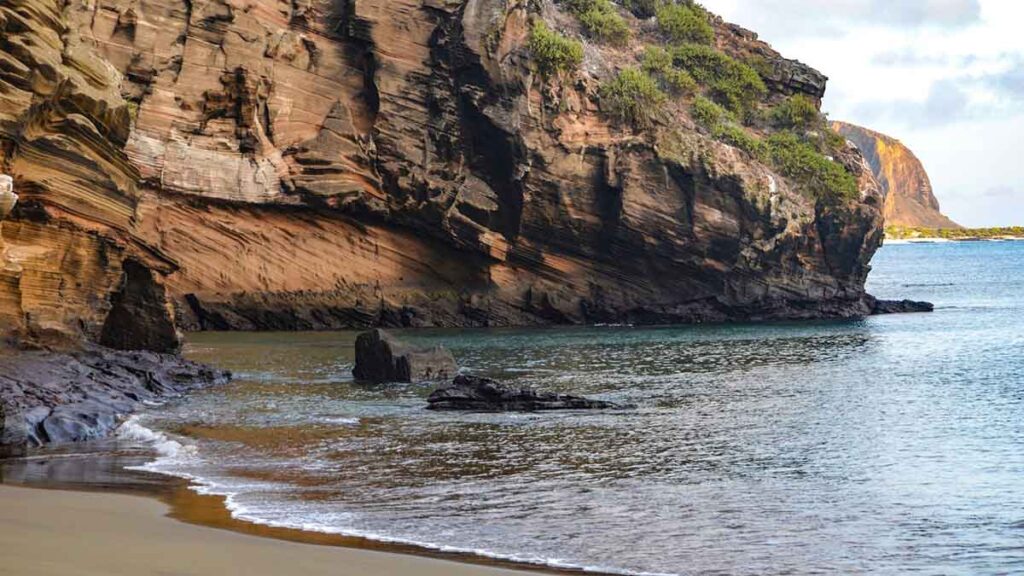
On 17 September 1835, a twenty-six-year-old naturalist named Charles Darwin climbed ashore on a black lava shore that the crew of HMS Beagle called Chatham Island. Today we know it as San Cristóbal — the easternmost island in the Galápagos archipelago and the one that, more than any other, changed the course of scientific history.

Darwin spent four days exploring the island. He noted the otherworldly landscape — the cracked lava fields, the sparse vegetation, the curious creatures that showed no fear of humans. He observed mockingbirds that seemed, island by island, to differ in small but consistent ways. He noticed that tortoises from different islands carried subtly different shells. None of these observations made immediate sense to him in the field; it was only years later, working through his notebooks, that the pattern crystallised into what would become the theory of evolution by natural selection.

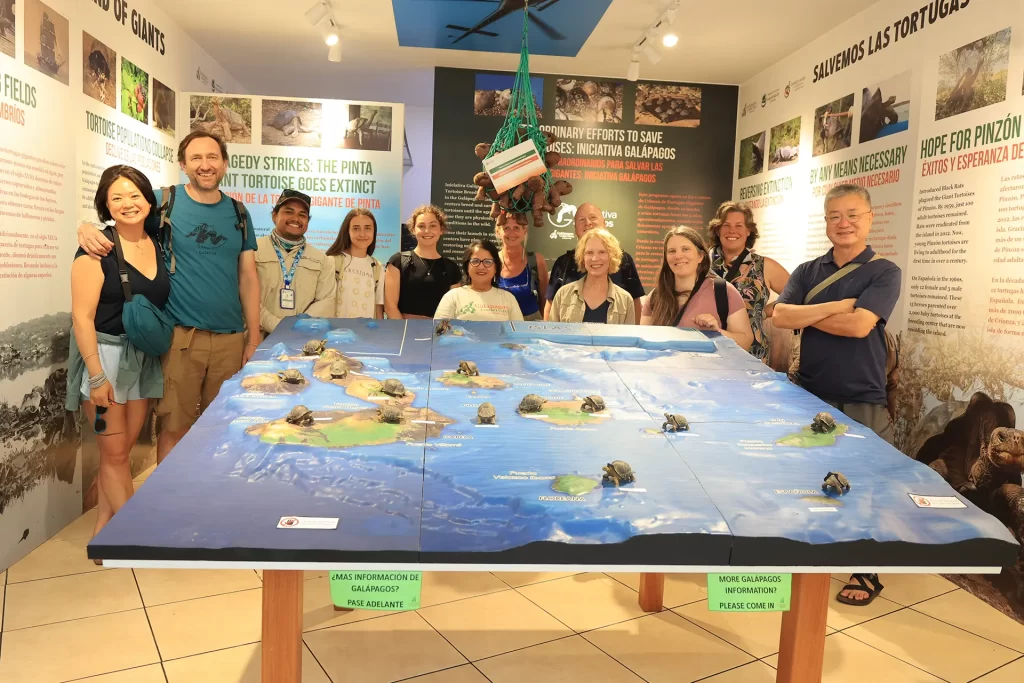
Visitors to San Cristóbal today walk almost exactly the terrain Darwin walked. The Centro de Interpretación — the Interpretation Center on the edge of Puerto Baquerizo Moreno — is the best place to frame the experience. Its permanent exhibits trace the geological formation of the archipelago, Darwin’s voyage, the disastrous history of human colonisation attempts, and the modern conservation movement that turned near-catastrophe into one of the world’s most successful protected ecosystems.

The Interpretation Center is free to enter and a recommended first stop for any visitor. From there, a short walk along the coast leads to Cerro Tijeretas (Frigatebird Hill), where you can look out over the bay and — on a clear morning — pick out the distinctive silhouette of Kicker Rock rising from the sea. Darwin would have seen the same view.

Puerto Baquerizo Moreno — The Town

San Cristóbal’s capital is also the capital of the entire Galápagos Province, which gives it a slightly different character from Puerto Ayora on Santa Cruz. It is home to the regional government, the naval base, and the province’s main administrative infrastructure. It is also considerably quieter and less commercially intense than Puerto Ayora — a fact that appeals strongly to independent travellers and those who want the Galápagos experience without the cruise-ship crowds.

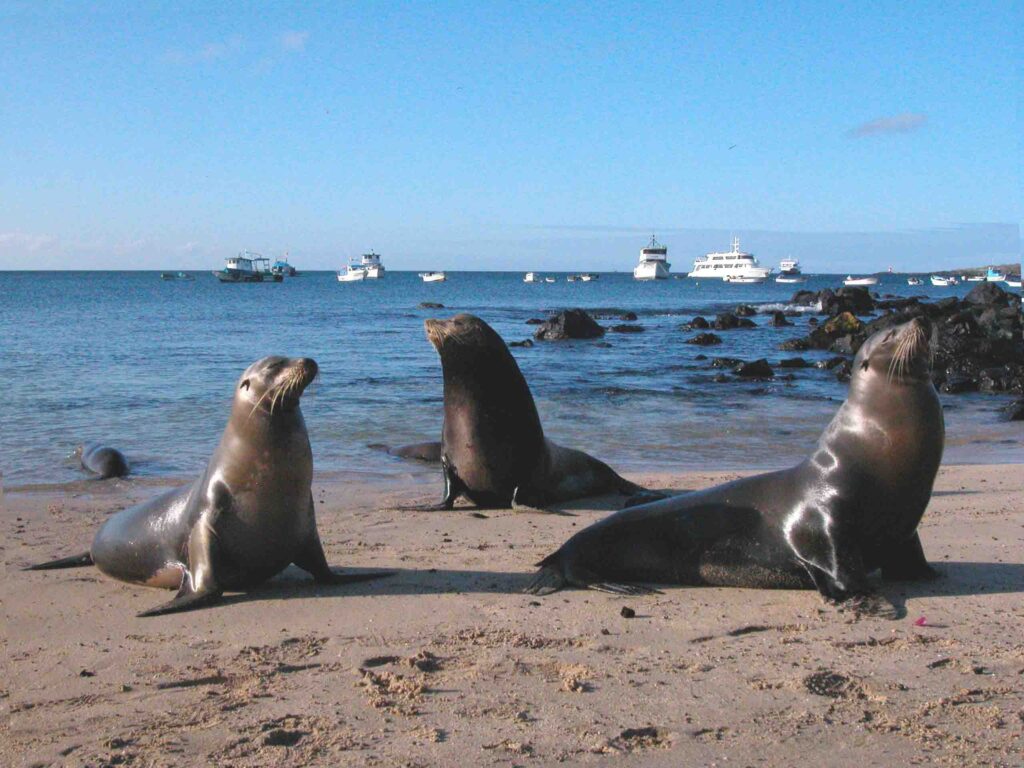
The town’s defining feature is its sea lions. The colony that occupies Puerto Baquerizo Moreno is not a distant attraction you take a boat to reach — it is the town itself. Thick-necked bulls haul out on the benches in the main plaza. Females and juveniles drape themselves across the concrete steps of the port, snooze under restaurant tables, and roll through the shallows in front of the malecón. They are, technically, wild animals; in practice, they are the most habituated sea lions in the archipelago, and they pay tourists approximately zero attention.

The surf culture is the other defining thread. San Cristóbal has the best and most consistent surf in the Galápagos, and a small but genuine surf community has built up around it. Boards are available for rent, and several operators offer lessons and guided sessions. The main accessible break — Punta Carola — is a fifteen-minute walk from the town centre. La Lobería, further along the coast, is more powerful and more rewarding for experienced surfers.

Compared with Puerto Ayora, Puerto Baquerizo Moreno has fewer restaurants and tour agencies but a more authentic daily rhythm. The malecón at sunset, when the sea lions are active and the frigatebirds wheel overhead from Cerro Tijeretas, is one of the quieter pleasures of the Galápagos.

Kicker Rock (León Dormido) — The Headline Experience

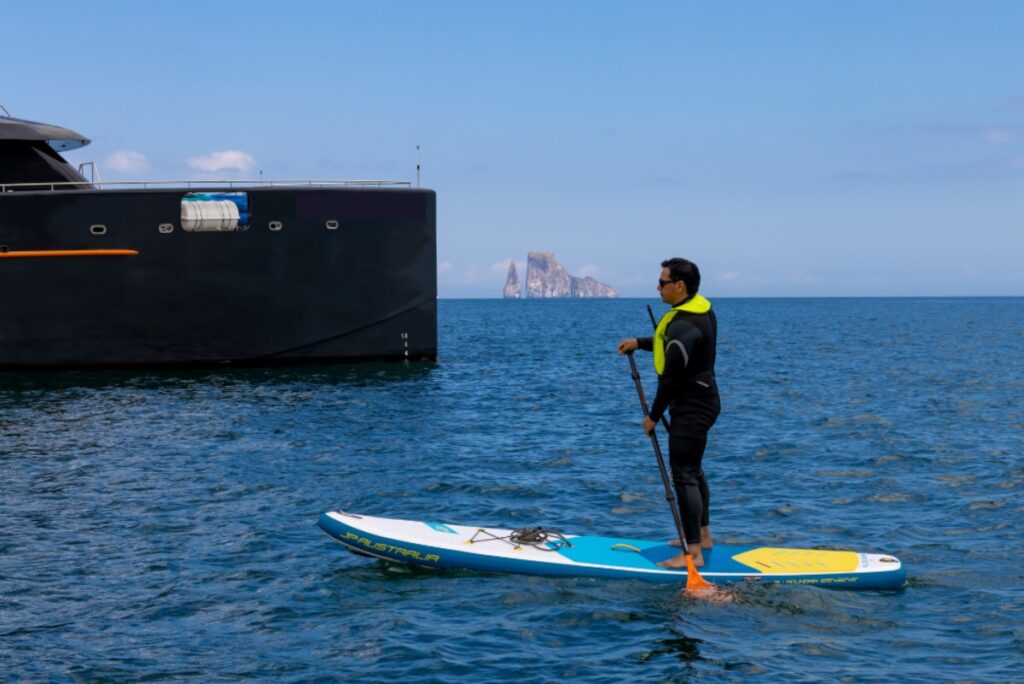
From any elevated point on San Cristóbal’s north coast, you can see it: two vertical columns of volcanic tuff rising abruptly from the ocean surface, leaning slightly toward each other, separated by a narrow channel. From the west they look like the sole of a boot propped at an angle — hence the English name, Kicker Rock. In Spanish the formation is León Dormido, the Sleeping Lion, which captures the profile seen from the east.

The channel between the two columns is where the experience happens. On a standard day tour — which departs Puerto Baquerizo Moreno around 08:00–08:30 and returns by mid-afternoon — boats anchor at the outer edge and snorkellers enter the channel. The depth ranges from relatively shallow near the walls to open water in the centre, and the current moves through steadily. This creates a drift-snorkel condition: you enter at one end, float through the channel with the current, and exit at the other.

The species list is long: Galápagos sharks and white-tip reef sharks patrol the floor, hammerhead sharks (usually scalloped hammerheads) are seen regularly, green sea turtles cruise alongside snorkellers with total indifference, spotted eagle rays sweep through in formation, and large pelagic fish move in and out with the current. Sea lions from a nearby colony often join in for the entertainment value.

Dive operators offer two-tank scuba dives at the site. Snorkelling is excellent and does not require prior dive experience, but divers who make it to the bottom of the channel encounter hammerheads at close range in a way that ranks among the best shark encounters available in the entire Pacific. Navigation time from Puerto Baquerizo Moreno is approximately 45 minutes to one hour each way.

Day tours from San Cristóbal typically combine Kicker Rock with a beach stop — either Cerro Brujo or Manglecito — allowing passengers to rest, swim, and look for shorebirds before the return. The full day runs approximately 7–8 hours.

Visitor Sites

Land-Based

La Lobería

La Lobería

Sea lions, marine iguanas, and a point break. About 30–40 minutes on foot from town or a short taxi ride to the trailhead. One of the most complete land-based wildlife experiences accessible without a tour boat.

Cerro Brujo

Cerro Brujo

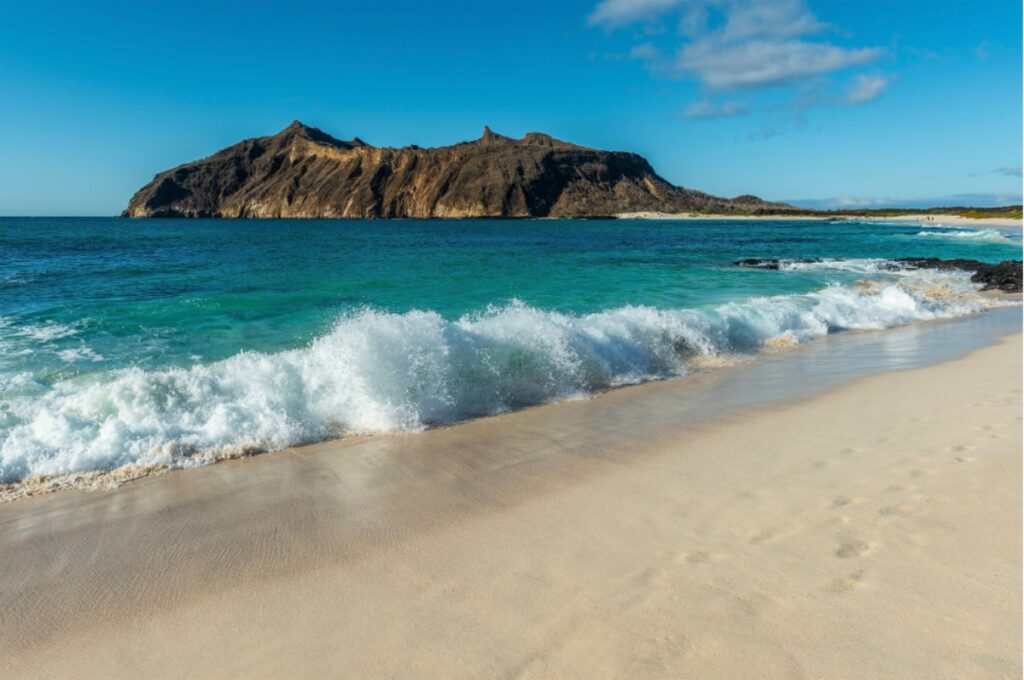
A wide white-sand beach considered one of the most beautiful in the Galápagos. Sea lions rest in the shallows, blue-footed boobies dive offshore, and marine iguanas patrol the shoreline. AAccess is strictly by boat from Puerto Baquerizo Moreno, included in most day-tour itineraries that also visit Kicker Rock.

Galapaguera de Cerro Colorado

Galapaguera de Cerro Colorado

The tortoise reserve in the highlands. Semi-wild population of San Cristóbal giant tortoises (Chelonoidis chathamensis). Open daily approximately 06:00–18:00. Accessible by taxi, private vehicle, or the Sunday public bus that departs from the Municipal Market at 08:00 and continues to the reserve (approximately USD 2 each way). Best visited in the morning when tortoises are more active.

Interpretation Center (Centro de Interpretación)

Interpretation Center (Centro de Interpretación)

Free entry. Widely considered the best natural history museum in the Galápagos. Covers the archipelago’s geological formation, Darwin’s 1835 voyage, the history of human settlement and ecological disaster, and the modern conservation framework under the Galápagos National Park. Approximately a 20–25 minute walk from the town centre or a USD 2 taxi ride. Recommended as a first stop for any multi-day visit to San Cristóbal — the context it provides transforms every subsequent wildlife encounter.

Punta Pitt — All Three Booby Species (Cruise Visitors Only)

Punta Pitt — All Three Booby Species (Cruise Visitors Only)

At the northeastern tip of the island, Punta Pitt is the only site in the entire Galápagos where all three booby species — blue-footed, Nazca, and red-footed — can be observed together in the same colony. Red-footed boobies are otherwise difficult to see in the archipelago. Punta Pitt is accessible via liveaboard cruises or specialized full-day tours departing on specific days from Puerto Baquerizo Moreno.

Surfing San Cristóbal

Surfing San Cristóbal

San Cristóbal is the surf capital of the Galápagos. Several breaks suit different ability levels:

Punta Carola — 15 minutes’ walk from town; right point break over rock; best November–April on north swells; suitable for intermediate to advanced surfers El Tongo (Tongo Reef) — long left point break; best April–November on south and south-west swells; sections for beginners, intermediate, and experienced surfers La Lobería — the most powerful break; works year-round; experienced surfers only at larger sizes El Cañón — consistent left-hander near the military base; accessible November–April

Surfboard and wetsuit rentals are available in Puerto Baquerizo Moreno. Surf lessons and guided sessions are offered by local operators.

Getting to San Cristóbal

By Air

San Cristóbal Airport (IATA: SCY) receives direct flights from Quito (UIO) and Guayaquil (GYE) on the mainland. LATAM and Avianca operate scheduled services. Flight time is approximately 1 hour 45 minutes from Quito and approximately 1 hour 30 minutes from Guayaquil. Flights typically depart in the morning. A Galápagos National Park entrance fee (currently USD 200 for international adults; USD 100 for children under 12) is payable in cash on arrival.

By Ferry from Santa Cruz

A high-speed ferry service runs daily between Puerto Baquerizo Moreno and Puerto Ayora (Santa Cruz). Journey time is approximately 2–2.5 hours; the crossing can be rough. Ferries typically depart Puerto Ayora in the morning and return from San Cristóbal in the afternoon, though schedules vary by operator and season. The crossing passes open ocean and a seasickness remedy is advisable. Cost is approximately USD 30–35 each way.

See also: best time to visit for month-by-month guidance on weather and wildlife.

Where to Stay

Puerto Baquerizo Moreno has a range of accommodation from budget guesthouses to mid-range boutique hotels. The town is small enough that almost all properties are within a short walk of the waterfront and tour departure points. Options span simple family-run hostals, mid-range hotels with pools, and a small number of higher-end properties. For a curated, up-to-date list of properties with current availability and pricing, see hotels on this site.

Wildlife — Land-Based

Sea Lions at La Lobería

La Lobería — ‘the place of sea lions’ — is a beach about thirty minutes on foot south-west of town, or a five-minute taxi ride to the trailhead followed by a short walk. The colony here is larger and more undisturbed than the town beach sea lions: bulls are territorial, pups are learning to swim in the rock pools, and the general noise level is considerable. Marine iguanas share the beach, moving in slow processions between the rocks and the surf. The point break at the western end of the beach is San Cristóbal’s most powerful surf spot and the most rewarding for experienced surfers.

Mimus melanotis

Endemic Species: San Cristóbal Mockingbird and Lava Lizard

Mimus melanotis

San Cristóbal has two endemic subspecies that naturalists specifically seek out. The San Cristóbal mockingbird (Mimus melanotis) is one of four Galápagos mockingbird species and is found only on this island and the small islet of Isla Lobos nearby. It is inquisitive and approachable — exactly the kind of bird Darwin observed with fascination. The San Cristóbal lava lizard is the endemic form found across the island’s lava fields and beaches; males display their characteristic bright-red throat patches during territorial displays.

Giant Tortoises at Galapaguera de Cerro Colorado

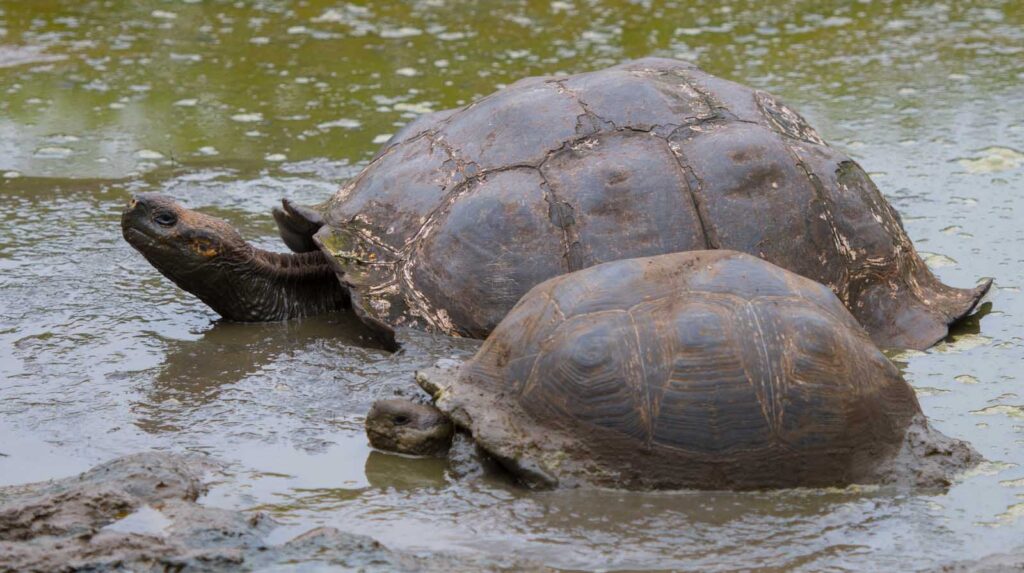
The tortoise reserve at Galapaguera de Cerro Colorado is located approximately 24 km from Puerto Baquerizo Moreno — around 45 minutes by road — in the island’s humid highlands. Unlike the breeding centres on Santa Cruz, Cerro Colorado maintains a semi-wild population: tortoises roam freely within a large enclosed area and are not kept in pens. Visitors walk marked trails through the reserve and encounter tortoises at close but natural range. The subspecies here — Chelonoidis chathamensis — is distinct from the Santa Cruz tortoise and from all other Galápagos tortoise populations.

La Junco

La Junco lagoon sits in the crater of an extinct volcano at approximately 700 metres elevation in the island’s highlands, 19 km from Puerto Baquerizo Moreno (roughly 30 minutes by road through the settlement of El Progreso). It is the only permanent freshwater lake in the entire Galápagos archipelago — a distinction that made San Cristóbal the first island to support permanent human settlement. The lake was formed when a volcanic crater collapsed and filled with rainwater over thousands of years; it holds approximately 360,000 cubic metres of water and spans a diameter of 270 metres.

The birdlife at La Junco is the main draw. White-cheeked pintail ducks are resident. Frigatebirds descend to the surface to wash salt from their feathers — the only place in the Galápagos where they can do so in fresh water. The San Cristóbal mockingbird and various Darwin’s finches are common in the surrounding vegetation. A 15–20 minute uphill trail from the car park reaches the crater rim, and a loop trail around the full lake takes approximately 30 additional minutes. Entry is free. Mornings offer the best chance of clear skies before highland cloud rolls in.

Marine Iguanas and Green Sea Turtles

Marine iguanas are common on the beaches and rocky shores outside Puerto Baquerizo Moreno, particularly at La Lobería and Cerro Brujo. Green sea turtles nest on several of San Cristóbal’s beaches; Cerro Brujo is a known nesting site. Nesting season runs broadly from December through April, with hatchlings emerging later in the season.

Plan Your Visit

San Cristóbal rewards a minimum stay of three nights and ideally five: one day for Kicker Rock, one day for the highlands (La Junco and Cerro Colorado tortoises), one day for the town and the Interpretation Center, and additional time for La Lobería, Cerro Brujo, and any surf sessions. Most visitors combine San Cristóbal with Santa Cruz and/or Isabela using the inter-island ferry.

Travel trade

Latin Trails (DMC partner)

Latin Trails operates FIT and group programs based out of Santa Cruz. Contact the DMC team for net rates, private transfers, and custom highland itineraries.

Latin Trails — contact the DMC team →

Frequently Asked Questions

Is San Cristóbal or Santa Cruz better as a base?

Both are viable bases, but they suit different travel styles. Santa Cruz (Puerto Ayora) has more restaurants, agencies, and day-tour options covering the central archipelago. San Cristóbal is quieter, has sea lions in town, better surf, and Kicker Rock right on its doorstep — it is the stronger choice for independent travellers who want authentic atmosphere and are less interested in maximising island coverage. For cruise passengers, the question rarely arises: most itineraries visit both.

Can I see hammerhead sharks at Kicker Rock?

Yes. Scalloped hammerhead sharks are regularly seen at Kicker Rock, particularly in the channel between the two rock columns. Sightings are more common for divers at depth than for snorkellers, but surface snorkellers also encounter them. The best hammerhead encounters in the Galápagos generally occur at Darwin and Wolf islands (cruise-only, far north), but Kicker Rock is the most accessible site where a hammerhead sighting is genuinely probable.

Is San Cristóbal good for surfing?

San Cristóbal has the best and most consistent surf in the Galápagos. Multiple breaks suit different skill levels and work at different times of year: Punta Carola and El Cañón favour north swells (November–April); La Lobería and El Tongo favour south swells (April–November). Boards and wetsuits can be rented in Puerto Baquerizo Moreno, and surf lessons are available. The experience of surfing alongside sea lions in the middle of a UNESCO World Heritage Site is, by most accounts, surreal.

How do I get from San Cristóbal to Santa Cruz?

The most common route is by high-speed ferry: daily boats run between Puerto Baquerizo Moreno and Puerto Ayora, taking approximately 2–2.5 hours. The crossing is open ocean and can be choppy; take a seasickness precaution if you are susceptible. An alternative is to fly via private charter flights between SCY and Baltra, though scheduled commercial inter-island flights from San Cristóbal primarily serve Isabela.

Did Darwin really land on San Cristóbal first?

Yes. San Cristóbal, then charted as Chatham Island by the British, was the first of the Galápagos Islands where Darwin went ashore. He landed on 17 September 1835 and spent four days exploring the island before the Beagle continued to Floreana. His notes from Chatham Island — particularly observations of the mockingbirds — were among the most important raw material for the thinking that eventually produced On the Origin of Species.