He wasn’t looking for a tortoise — the man who eventually found Lonesome George. In 1971, a Hungarian scientist named József Vágvölgyi had come to Pinta Island to study land snails — the island’s mollusks, not its megafauna. Pinta’s tortoises were considered gone. Whalers had been taking them since the 17th century, and then in 1959, fishermen released a small number of goats on the island and walked away. Forty thousand goats later, the vegetation was stripped to bare rock and grey scrub. There was nothing left for a tortoise to eat. And yet Vágvölgyi looked up from his snails and saw one.
News reached the scientific community slowly, the way things did then. Galápagos National Park rangers returned to Pinta in spring 1972 and confirmed it: a single adult male, living alone on a ruined island. They brought him to the Fausto Llerena Breeding Center at the Charles Darwin Research Station on Santa Cruz Island and placed him in an enclosure that would remain his home for the next four decades.
Lonesome George’s name came from the American press — borrowed from a TV comedian — and someone decided it fit. It did. There was no precedent in recorded conservation history for what he represented: the absolute last known individual of an entire species, still alive, still moving at that unhurried tortoise pace, in an enclosure on a research station island while scientists figured out what, if anything, could be done. His caretaker was an Ecuadorian named Fausto Llerena, who came to work at the station not long after George arrived and stayed until the end. His name is on the breeding center now.
Decades of searching turned up nothing. Genetic surveys swept through zoo collections worldwide, through the profiles of captive tortoises on multiple continents. Field teams returned to Pinta. No other abingdonii ever surfaced. But the program continued regardless. Females from Wolf Volcano on Isabela shared George’s enclosure for a time, then females from Española after genetic analysis identified them as the closest relatives. George showed some interest. No surviving offspring ever resulted.
On the morning of June 24, 2012, Fausto Llerena found George stretched out near his watering hole, motionless. He was estimated at over 100 years old. Cause of death: natural causes.
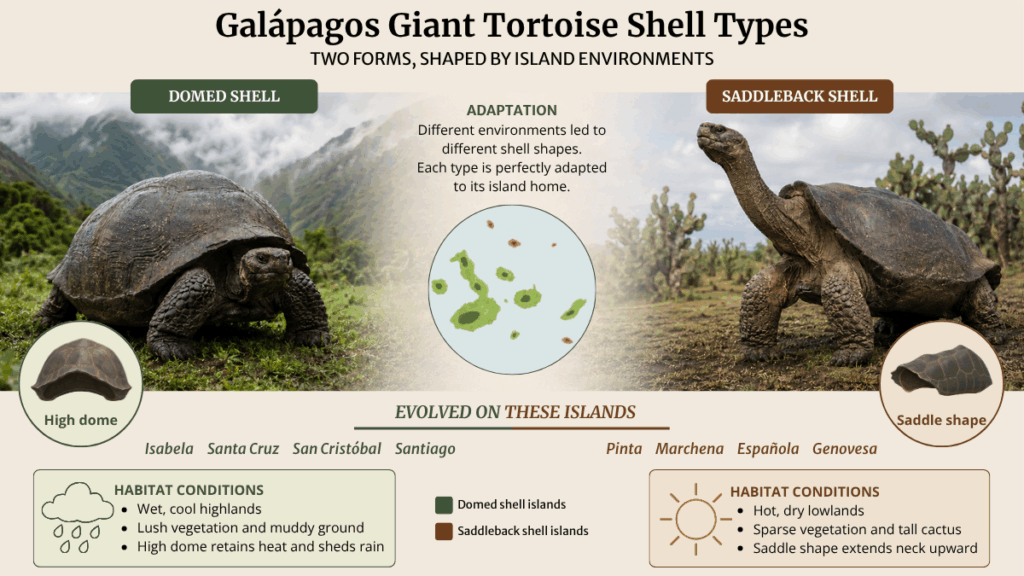
His body was flown to the American Museum of Natural History in New York, where the taxidermists faced a problem no one had solved before: modern giant tortoise taxidermy, at this scale, with this animal, with no margin for error and no reference to copy. It took nearly three years. What came back shows him at full extension — neck outstretched, legs fully deployed, reaching 1.52 meters in height — and that posture captures exactly what a saddleback tortoise looks like when it reaches for something just beyond its reach.
He came back to Galápagos on February 17, 2017. He’s now on display in the Symbol of Hope Hall at the Fausto Llerena Breeding Center, inside the “La Ruta de la Tortuga” interpretive trail on Santa Cruz Island — preserved behind UV-protective acrylic in a climate-controlled chamber, open daily from 8:00 to 18:00.
Genetic surveys of Wolf Volcano tortoises on Isabela have found individuals carrying Pinta ancestry — descended, most likely, from tortoises that whalers offloaded on Isabela centuries ago. No individual carries pure abingdonii genetics. But the lineage hasn’t vanished completely. Selective breeding programs using these hybrid tortoises may eventually produce animals genetically close enough to restore to Pinta. Work ongoing, patient, and measured in decades — which is, for a tortoise, a reasonable timeframe.