
The Galápagos Islands are home to over 9,000 species, with 80% of land birds, 97% of reptiles, and 20% of marine species found nowhere else on Earth. The defining characteristic: animals evolved without terrestrial predators and show no fear of humans. Sea lions, tortoises, and boobies behave as if visitors do not exist.
Galapagos Wildlife
A Species Guide for Every Traveler
Wildlife at a Glance
The Galápagos host 9,000+ species. Approximately 80% of land birds, 97% of reptiles, and 20% of marine species are endemic. The archipelago hosts 15 iconic species including giant tortoise, marine iguanas, blue-footed boobies, and Galápagos penguins, the only penguin species found north of the equator.
Source: Charles Darwin Research Station, 2023
97% of Galápagos reptile species are found nowhere else on Earth.
Source: Charles Darwin Research Station (CDRS), 2023
Why Galápagos Wildlife Is Unlike Anywhere Else
The Galápagos evolved 1,000 km from any continent, in isolation and without large terrestrial predators. The result is behavioral: animals here show no instinctive fear of humans. Sea lions sleep beside hikers on Gardner Bay. Blue-footed boobies dance within arm’s reach. Mockingbirds land on camera bags.
Endemism rates are extreme. Roughly 80% of land bird species, 97% of reptile species, and 100% of giant tortoise subspecies are island-specific: a tortoise from Española Island is genetically distinct from one on Pinzón 100 km away. The Galápagos is one of the few places where evolution can still be observed at a population level.
Darwin’s finches remain the textbook case: 18 recognized species, all descended from a single ancestral finch, varying in beak shape, diet, and song. Still the most cited case of adaptive radiation in evolutionary biology.
Browse by Wildlife Category
Birds
58 species | 28 endemic | Best seen: North Seymour, Española, Genovesa
The Waved Albatross (4 m wingspan, only nests on Española) and the Blue-footed Booby (mating dance performed year-round) are the most sought-after species. The flightless cormorant, the world’s only cormorant that cannot fly, lives only on Isabela and Fernandina. See also land birds
Reptiles
7 iguana species | 13 tortoise subspecies | Best seen: Santa Cruz, Isabela, Fernandina
Marine iguanas are the world’s only sea-going lizard, found on every island. The giant tortoise lives over 170 years; approximately 20,000 remain across 13 subspecies, each island-specific.
Source: Galápagos National Park (PNG), 2022
Mammals
~50,000 Galápagos sea lions | Whale sharks at Darwin & Wolf: June–November
Galápagos sea lions and fur seals are the two resident pinnipeds. Bottlenose and common dolphins regularly escort cruise ships. Whale sharks aggregate at Darwin and Wolf Islands from June to November, which is the single largest marine wildlife event in the archipelago.
Marine Life
2,900 marine species | Snorkeling from day 1 | Best: Darwin & Wolf for sharks
The cold Humboldt Current and warm Panama Current meet at the Galápagos, creating nutrient-rich water supporting 2,900 marine species. Manta rays, hammerhead sharks, green sea turtles, and the Galápagos penguin are all visible from snorkeling depth.
When to See What
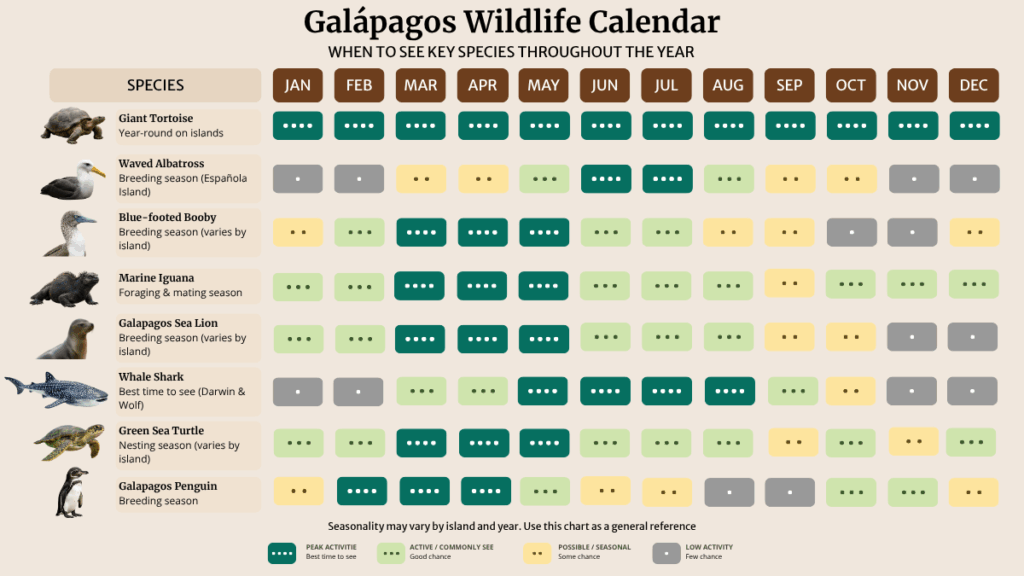
Key Wildlife Activity: Sea turtle nesting; marine iguana hatching; waved albatross arriving on Española in April; calmer seas, warmer snorkeling conditions.
Key Wildlife Activity:Blue-footed booby mating peaks; whale sharks at Darwin and Wolf Islands (Jun–Nov); Galápagos penguin activity peaks; sea lion pups born ~November.
Key Wildlife Activity: Giant tortoises at El Chato Reserve (Santa Cruz) and breeding centers; marine iguanas on every coastline; active sea lion colonies throughout the archipelago.
Wildlife-Focused Cruise Options
Every Galápagos cruises carries a National Park-certified naturalist guide. Itinerary choice drives which species you see:
- Western routes (Isabela, fernandina): highest density of marine iguanas and flightless cormorants
- Northern routes (Genovesa): red-footed boobies, Nazca boobies, frigatebirds
- Liveaboard dive routes (Darwin, Wolf): whale sharks, hammerheads, manta rays
Planning around peak activity? See best-time-to-visit, or step up to a luxury.

When to See What
Key Wildlife Activity: Sea turtle nesting; marine iguana hatching; waved albatross arriving on Española in April; calmer seas, warmer snorkeling conditions.
Key Wildlife Activity:Blue-footed booby mating peaks; whale sharks at Darwin and Wolf Islands (Jun–Nov); Galápagos penguin activity peaks; sea lion pups born ~November.
Key Wildlife Activity: Giant tortoises at El Chato Reserve (Santa Cruz) and breeding centers; marine iguanas on every coastline; active sea lion colonies throughout the archipelago.
Wildlife-Focused Cruise Options
Every Galápagos cruises carries a National Park-certified naturalist guide. Itinerary choice drives which species you see:
- Western routes (Isabela, fernandina): highest density of marine iguanas and flightless cormorants
- Northern routes (Genovesa): red-footed boobies, Nazca boobies, frigatebirds
- Liveaboard dive routes (Darwin, Wolf): whale sharks, hammerheads, manta rays
Planning around peak activity? See best-time-to-visit, or step up to a luxury.
Wildlife-Focused Cruise Options
- Western routes (Isabela and Fernandina): highest density of marine iguanas and flightless cormorants
- Northern routes (Genovesa): red-footed boobies, Nazca boobies, frigatebirds
- Liveaboard dive routes (Darwin, Wolf): whale sharks, hammerheads, manta rays
Frequently Asked Questions
The Galápagos giant tortoise. “Galápagos” derives from the old Spanish word for saddle, describing the tortoises’ saddle-shaped shells. The longest-lived reach 175 years. Lonesome George, the last Pinta Island tortoise, who died in 2012, became one of conservation’s most recognizable symbols.
No. Galápagos wildlife evolved without terrestrial predators and has no instinctive fear of humans. National Park regulations require all visitors to stay 2 meters from wildlife; the regulation exists to protect the animals’ behavior, not because the animals will retreat.
Yes. Snorkeling with sea lions is one of the most common activities on naturalist cruises and day trips. Sea lions are highly interactive in the water. Gardner Bay (Española) and waters around Isabela are considered the best sites.
Approximately 1,900 species are found nowhere else on Earth, including 18 finch species, 13 tortoise subspecies, 7 iguana species, the flightless cormorant, and the Galápagos penguin. (Source: Charles Darwin Research Station, CDRS, 2023)