
Española Island — Where the Waved Albatross Nests and Tortoises Were Saved

Juan Magallanes, Naturalist Expert Contributor

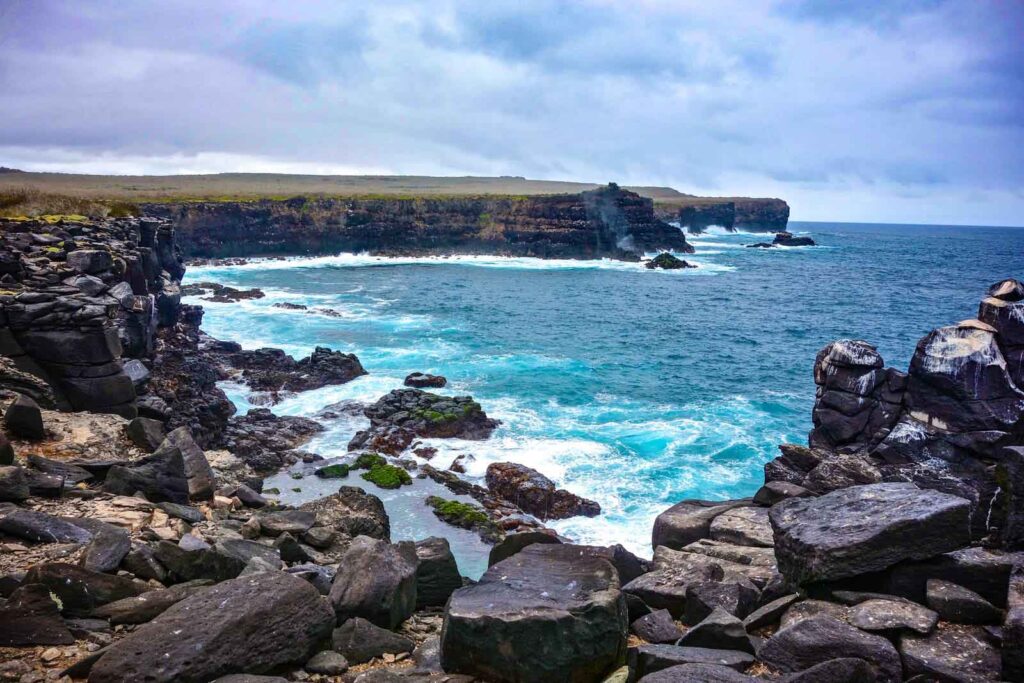
Española (Hood Island) is the southernmost island in the Galápagos and the only place on Earth where the waved albatross nests — approximately 12,000 breeding pairs arrive each April. It is also home to one of conservation's great success stories: the Española tortoise, which recovered from 14 wild individuals to over 2,000. The island is accessible by cruise only.

At a Glance

The Only Albatross Colony on Earth

There is one fact about Española that no other island in the Galápagos — or anywhere else on the planet — can claim: every waved albatross alive today was either born on this island or will return here to breed. The entire global nesting population of Phoebastria irrorata, the waved albatross, concentrates on a single windswept plateau at Punta Suárez. Approximately 12,000 breeding pairs arrive each April and, for those eight months, Española hosts the most extraordinary avian spectacle in the Pacific.

The waved albatross is a large seabird — wingspan reaching up to 2.4 metres — named for the wave-like pattern of fine brown scalloping across its back and wings. Outside the nesting season, these birds range across the eastern tropical Pacific, soaring effortlessly on fixed wings for weeks at a time. But each April, without fail, they return to Española. The island’s southern cliffs provide the long, unobstructed runway these birds need: albatrosses cannot take off from flat ground without wind assistance, and Suárez Point delivers both the elevation and the reliable trade winds.

Courtship on Española is theatrical in a way that few wildlife encounters match. Pairs perform an elaborate sequence of ritualised displays — sky-pointing, bill circling, clacking, and a kind of slow-motion dance that ornithologists have documented as one of the most complex courtship behaviours in birds. For a visitor standing among a colony of thousands, the sound is constant: deep bill-clapping, low calls, the shuffle of wings. Chicks, covered in brown down, are present from roughly July onward and remain through December, when the adults depart for sea.

Seasonality is worth stating plainly: between January and March, Española’s famous albatross population is entirely at sea. Visitors who arrive during those months will find the clifftops quiet. The breeding season — April through December — is when the colony is active, the courtship displays are visible, and chicks can be observed at close range.

UNESCO has identified Española as critical habitat for the waved albatross, and the species is listed as Vulnerable on the IUCN Red List — population pressures including longline fishing bycatch at sea remain concerns. The Galápagos National Park maintains strict visitor protocols at Suárez Point precisely to protect nesting activity. Visitors follow marked paths and maintain the required distance; the reward is intimate proximity to nesting pairs within metres of the trail.

The Tortoise That Came Back — Diego's Story

In the 1960s, biologists surveying Española for Galápagos tortoises found almost nothing. Feral goats, introduced by passing ships over the preceding century, had stripped the island’s vegetation to bare rock in places. The tortoises — Chelonoidis hoodensis, a subspecies found nowhere else on Earth — had been reduced to a remnant population that barely qualified as a species. When researchers counted what remained, they arrived at a number that has since become one of conservation’s most cited statistics: 14 individuals. Twelve females and two males. A species balanced on the edge of arithmetic impossibility.

The discovery triggered an emergency response. The surviving tortoises were collected and moved to the Charles Darwin Research Station on Santa Cruz Island, where a captive breeding programme was established under the coordination of the Galápagos National Park Directorate. The science was straightforward; the biology was fragile. With only two males and twelve females, the genetic diversity of an entire subspecies depended on whether those animals would breed in captivity — and whether their offspring could eventually stabilise a wild population.

Enter Diego. A male Española tortoise had been living at San Diego Zoo for decades — exactly how and when he arrived remains somewhat uncertain, likely collected in the early twentieth century during one of the scientific expeditions that routinely gathered Galápagos specimens for zoological institutions. When researchers identified him as Chelonoidis hoodensis, Diego was repatriated to the Darwin Station. He proved extraordinarily prolific. Over the course of the breeding programme, Diego fathered an estimated 800 or more offspring — a figure that represents a substantial proportion of every tortoise living on Española today.

The programme worked. Captive-bred tortoises were released back onto Española over successive decades as goats were eradicated and vegetation recovered. The island rewilded itself with remarkable speed once the browsing pressure was removed; cactus, shrubs, and the endemic vegetation the tortoises had evolved with returned. Today the wild population is estimated at more than 2,000 individuals — a number that would have seemed impossible to anyone who stood on Española in 1965 and counted fourteen animals.

Diego was retired from the breeding programme in 2020 and returned to Española to live out his remaining decades on the island he helped save. The Española tortoise story is not a tale of technology or large investment — it is a story of patience, careful science, and one improbably productive old tortoise. It is, by any measure, one of the greatest conservation recoveries in the history of island ecology.

Christmas Iguanas and Other Wildlife

The Galápagos marine iguana is present on most islands in the archipelago, but the Española subspecies (Amblyrhynchus cristatus venustissimus) does something no other subspecies does: during breeding season, the males turn red and green. The colouration is vivid enough that local guides long ago gave them an informal name — Christmas iguanas. The exact timing of peak coloration varies, but the display is associated with the breeding season when males compete for females on the rocky shores. Visitors arriving between roughly December and January are most likely to see the full colour display, though some red-green patterning is visible for much of the year.

Suárez Point hosts a large, active nesting colony of blue-footed boobies (Sula nebouxii). The foot display these birds perform during courtship is one of the most reliably entertaining wildlife encounters in the Galápagos: males parade their vivid turquoise-blue feet in front of prospective partners in an unhurried, deliberate strut that visitors can observe from centimetres away. The vividness of the feet is believed to signal male fitness — the brighter the blue, the healthier the bird. Española’s Suárez colony is among the largest in the archipelago.

Nazca boobies (Sula granti) — formerly classified as Masked boobies, reclassified as a separate species — also nest on Española, identifiable by their white plumage, orange-yellow bill, and distinctive black mask around the face. Española supports colonies of both booby species simultaneously, which allows direct comparison in the field and is one of the reasons naturalist guides consider Suárez Point an exceptional site.

The Galápagos hawk (Buteo galapagoensis) — endemic to the archipelago and listed as Vulnerable — is more consistently visible on Española than on most other islands. The species is not common anywhere, but the island’s open terrain and abundant prey give it a foothold. Española reportedly hosts one of the largest populations in the park. Hawks often perch in the open and show little fear of humans, making close observation straightforward.

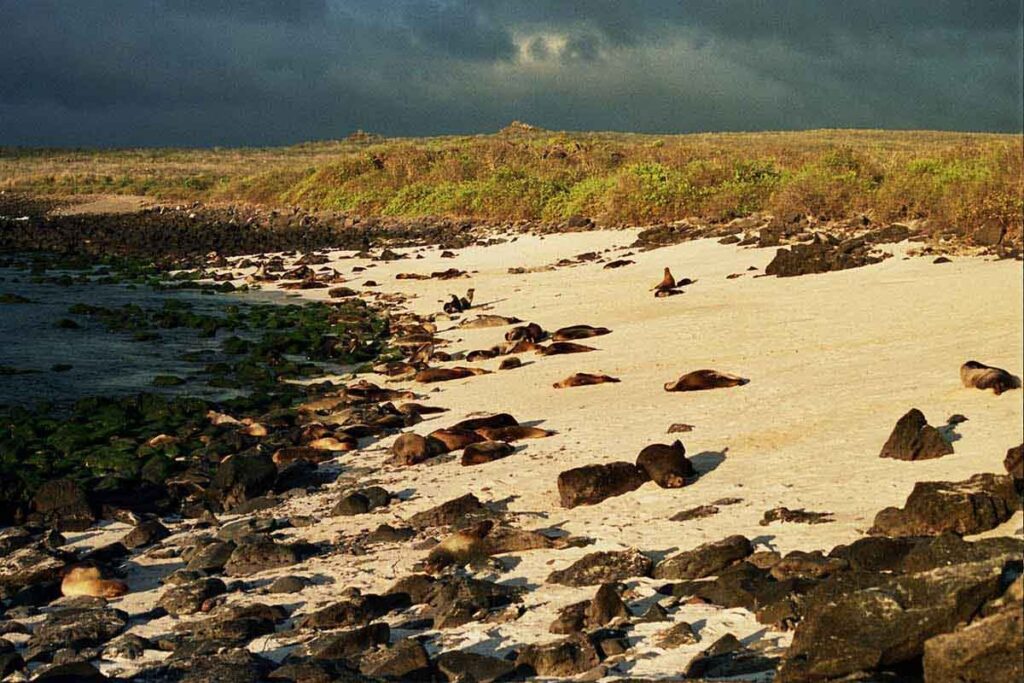
Gardner Bay, on the northeastern side of Española, supports a large sea lion colony. Galápagos sea lions (Zalophus wollebaeki) are present year-round; pups are born at various points throughout the year and the beach at Gardner Bay is one of the finest in the archipelago for observing sea lion social dynamics at close range. Galápagos doves (Zenaida galapagoensis), tame and often seen walking directly at visitors’ feet, are present throughout the island.

Visitor Sites

Land-Based

Getting There — Cruise and Day trip

Española is accessible by a multi-day cruise or a day trip from San Cristobal island as part of a land-based tour. There is no airport on the island, no dock for commercial ferries, and no infrastructure to support day-trippers – you should make sure you choose the proper day trip yacht. This is not a restriction but a reality of the island’s ecology: the Galápagos National Park limits the types of vessels and the number of visitors precisely to keep Española in the condition that makes it worth visiting.

The island’s southern position in the archipelago is a logistical fact: sailing from Santa Cruz (where most itineraries begin) to Española takes longer than reaching the central or northern islands. For this reason, Española does not appear on itineraries that typically focus on the central islands. Most itineraries that include Española run for 4 days or more, and several 8- to 10-day voyages place Española as a highlight of the southern loop.

Voyagers Travel Company can advise on which itineraries include Española and how to sequence a cruise that also takes in Fernandina and Genovesa — the other two premium-wildlife islands — if a comprehensive wildlife experience is the goal. See also: Best time to visit and our full cruises guide for itinerary comparisons.

Key logistics:

Day tours are possible from San Cristobal island

No ferry service to Española

Overnight cruise best option — minimum vessel: certified Galápagos cruise yacht

Typical itinerary length including Española: 7 days or longer

Shorter itineraries (4–5 days) also reach Española

When to Go — Seasonality Guide

Española rewards visitors differently depending on the month, and being honest about those differences helps travellers make a better decision than any generalised ‘best time’ recommendation.

The practical takeaway: if the waved albatross is the reason for the trip, any visit between April and November will deliver. If snorkeling and sea lions take priority, January to March offers excellent conditions and fewer visitors. No month is a ‘bad’ month on Española — the species mix shifts rather than disappearing.

See the seasonal wildlife calendar ↓
Plan Your Visit to Española Island
Direct travelers

Ready to see the world's only waved albatross colony?

Voyagers Travel Company builds custom Galápagos cruises that include Española. Our team handles itinerary design, vessel selection, and Galápagos National Park permits

Plan My Cruise →
Travel trade

Booking on behalf of clients?

Latin Trails is our DMC partner in the Galápagos for trade bookings. Competitive net rates, group allocations, and on-the-ground logistics.

Trade Enquiry →

Frequently Asked Questions

Is Española Island worth the longer cruise?

Yes — with one important caveat: ‘worth it’ depends on what you want from Galápagos. If the combination of the world’s only waved albatross nesting colony, an extraordinary tortoise conservation story, and one of the most dramatically situated visitor sites in the archipelago matters to you, Española is irreplaceable. No other island offers this specific combination. If you are constrained to a wester or central islands itinerary, you likely cannot reach Española on that trip — and the honest answer is that those itineraries cover the central islands excellently. Española requires commitment: a longer voyage, more sailing time, more exposure to open ocean conditions in the south. For wildlife-focused travellers, it is consistently rated as one of the most rewarding single days in the Galápagos.

When is the best time to see the waved albatross on Española?

April through December. The albatrosses return to Española each April and remain through approximately December, when adults and late-season chicks depart for sea. The peak of courtship display activity is generally April to June, when pairs are most actively performing the bill-circling, sky-pointing, and dancing sequences. July to September sees chicks on the ground and the colony at full population. From January to March, the albatrosses are absent from Española entirely — visitors will find a dramatically different (though still species-rich) island during those months.

Can I visit Española Island on a day trip?

Yes. Española has no airport, no commercial ferry connection, only accessible by day tours from San Cristobal island. The island is accessible exclusively by overnight cruise or from San Cristóbal only. The Galápagos National Park’s regulations and the practical sailing distance both limit day trips. If you are planning a trip specifically to see Española, an overnight cruise of at least a few days on San Cristobal is required.

What other wildlife lives on Española besides albatrosses?

Española is one of the most wildlife-dense islands in the Galápagos. Year-round residents include blue-footed boobies (large nesting colony at Suárez Point), Nazca boobies, Christmas marine iguanas (the most colourful marine iguana subspecies — red and green during breeding season), Galápagos hawks, sea lions at Gardner Bay, Galápagos doves, and marine turtles in the waters around Gardner Islet. The Española tortoise — recovered from 14 wild individuals to over 2,000 through captive breeding — is present on the island, though sightings in the wild are not guaranteed on a standard visitor itinerary.

How did the Española tortoise come back from near extinction?

By the 1960s, feral goats had devastated Española’s vegetation and the native tortoise population had crashed to just 14 wild individuals — 12 females and 2 males. The Galápagos National Park and Charles Darwin Research Station collected the survivors and established a captive breeding programme on Santa Cruz. A third male, Diego, was repatriated from San Diego Zoo — where he had lived for decades — and proved extraordinarily prolific, fathering an estimated 800+ offspring. Goats were eradicated from Española, vegetation recovered, and captive-bred tortoises were released over successive decades. The wild population today exceeds 2,000 individuals. Diego was retired to Española in 2020.