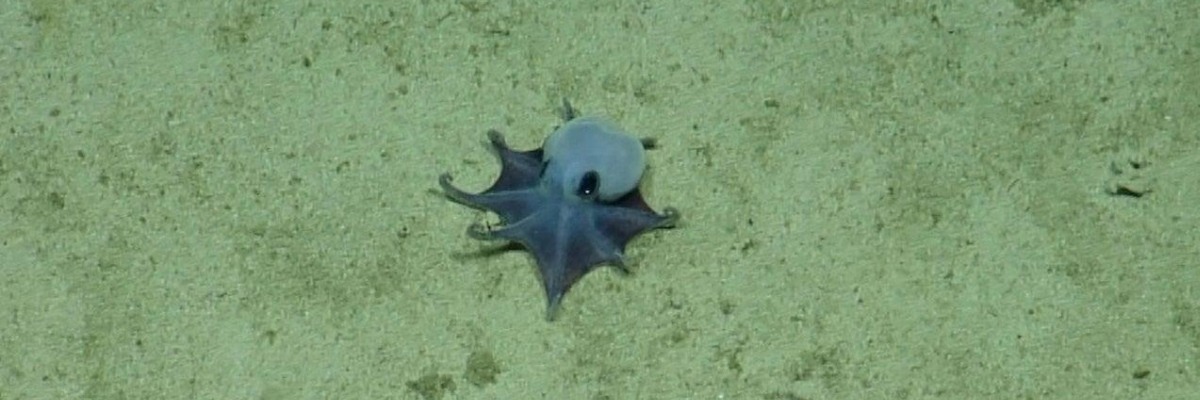
A small blue octopus found in deep water near the Galápagos Islands has been confirmed as a new species, after researchers used CT scans to examine the rare specimen without cutting it open.
The species has been named Microeledone galapagensis. It was first observed in 2015 during a deep-sea expedition, near Darwin Island at the northern edge of the Galápagos archipelago.
A remotely operated vehicle recorded the octopus close to an underwater mountain about 5,800 feet below the surface. The expedition team collected one specimen and filmed two other octopuses that appeared similar.
Researchers later described the collected animal as palm-sized, with reporting from the expedition noting that the blue octopus was roughly the size of a golf ball.
At a glance
- Species name: Microeledone galapagensis
- Location: near Darwin Island in the Galápagos Islands
- Depth: about 5,800 feet below the surface
- Study publication: Zootaxa
- Research method: CT scans used to examine internal anatomy
How researchers confirmed the species
Janet Voight, an author of the study, said the specimen appeared unusual from the beginning. “Right away, I knew it was something really special. I’d never seen anything like it,” she said.
The scientists had a problem common in work on rare deep-sea animals: only one collected specimen was available. Describing a new octopus species requires examination of structures such as the mouth, beak and teeth, but doing that physically would have meant cutting into the animal.
Instead, the team used CT imaging to inspect the specimen’s internal anatomy. The scans allowed researchers to view details of the mouth and other organs while keeping the original specimen intact.
Stephanie Smith, another author of the study, said the non-destructive approach was especially useful for type specimens, which serve as the reference examples for newly described species. Combining multiple scans also allowed the researchers to build a detailed 3D model of the octopus.
What the finding shows
The scans supported the conclusion that the Galápagos octopus was previously unknown to science. The study adds another species to the record of deep-sea life around the archipelago, where much of the surrounding ocean remains little explored.
Voight said the animals are rarely seen because they live in the deep sea. She also pointed to the scale of the Pacific Ocean as part of the reason discoveries like this remain possible, noting that the ocean is vast and still holds many unexplored habitats.