
The Galápagos giant tortoise (Chelonoidis niger complex) is the world's largest living tortoise. Between 15,000 and 25,000 individuals survive across 13 genetically distinct species on ten islands. Before human contact, an estimated 200,000–300,000 existed. The best place to see them in the wild is El Chato Reserve on Santa Cruz.
Sources: Galápagos National Park; Charles Darwin Research Station, 2025.
Galápagos Giant Tortoise:
Species Guide, Where to See Them & Conservation
If there is one animal that makes the Galápagos feel genuinely unlike anywhere else, this is it. Watching one move — the slow deliberateness of it, the ancient weight — you start to understand why these islands took their name from them. “Galápago” is an old Spanish word for saddle, a reference to the shell shape of the tortoises that 16th-century Spanish explorers encountered when they first sailed through the archipelago. As the largest living tortoise on Earth, it has been here long enough that the landscape has essentially shaped itself around them.
There are 13 genetically distinct species spread across ten islands. The Galápagos tortoise is the archipelago’s most iconic species. For the broader picture, see our wildlife guide.
The largest individuals weigh over 400 kg (880 lbs).
SOURCE: GALÁPAGOS NATIONAL PARK, PNG
They live for 150 to 200 years. This page covers the biology, the shell variation that helped inform Darwin’s thinking, all 13 subspecies by island, the full conservation history including Lonesome George, and the practical details of where and when to see these animals.
The Animal Itself
A large male Galápagos giant tortoise can weigh more than 400 kg and stretch nearly two meters from the tip of his extended neck to the base of his shell. Females run substantially smaller — 136 to 181 kg on average. Weight record: Goliath, a captive tortoise from Santa Cruz who reached 417 kg before his death in 2002.
More than just protection, the shell is a dense thermal mass — calcium-rich and slow to heat or cool — that helps the tortoise regulate body temperature without burning much metabolic energy. A tortoise sitting in the early morning sun is loading thermal energy that will carry it through a day of slow, efficient grazing. That metabolic frugality goes far enough that tortoises can survive up to a year without food or water, drawing on stored fat and fluid reserves. This physiological trait also, unfortunately, made them ideal provisions for sailing ships — which is how so many of them ended up in ship holds rather than on their islands.
Galápagos giant tortoises live 150 to 200 years, though pinning down exact ages for wild individuals is genuinely difficult. Lonesome George, the last Pinta Island tortoise, was estimated at over 100 years old when he died. A tortoise named Speed at the San Diego Zoo lived an estimated 150 years. Nobody has confirmed the actual upper limit — these animals were around before the record-keeping was.
They eat grasses, fallen fruits, cactus pads, and leaves. Their digestive tract retains food for extended periods, which means seeds they pass — sometimes kilometers from where they ate — get dispersed widely across the landscape. If you think about it, a tortoise moving through the Galápagos highlands is also moving seeds across terrain it has been shaping since before the islands had names.
Two Shells, Thirteen Islands
Shell shape is the most immediately visible difference between species, and you don’t need a trained eye to see it. Stand in front of two individuals from different islands at a breeding center, and you see it at once.
Domed Tortoises
Domed tortoises carry a high, rounded shell with a low, close-fitting front opening. These are the giants of the wetter islands — Santa Cruz, and the lush slopes of Alcedo and Wolf volcanoes on [INTERNAL LINK: Isabela Island → /islands/isabela/]. Vegetation on those islands grows dense and thick at ground level. A tortoise on Alcedo does not need to crane its neck to find a meal; it just has to walk forward. You’ll also notice that domed individuals are typically the largest animals you encounter at any breeding center.
Saddleback Tortoises
Saddleback tortoises are built differently. Front of the shell sweeps sharply upward, creating a wide notch above the neck that lets the tortoise raise its head nearly vertical. This is an adaptation to smaller, drier islands like [INTERNAL LINK: Española → /islands/española/] and Pinta, where water is scarce, ground-level vegetation is sparse, and the most nutritious option is often a cactus pad held two feet off the ground. If you look at the shell notch closely, it’s the tortoise’s answer to a specific architectural problem imposed by a specific island — an elegant one, frankly, arrived at without any shortcuts.
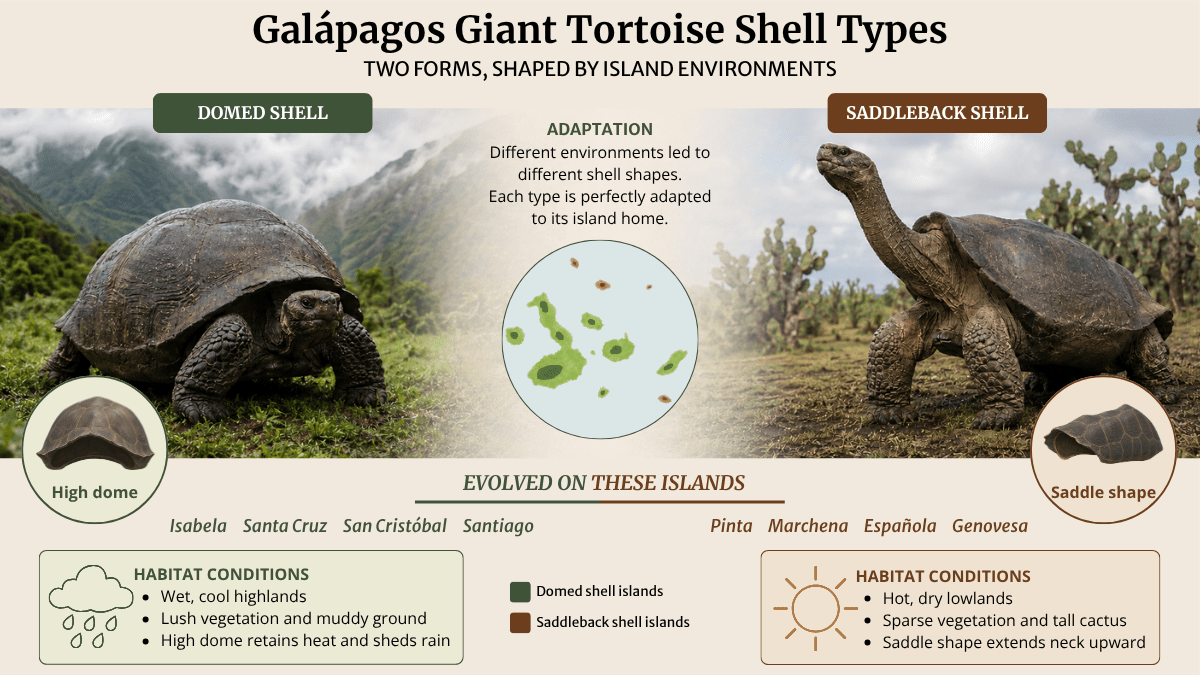
⬛ WEBMASTER DESIGN NOTE: INFOGRAPHIC — “Galápagos Giant Tortoise Shell Types”: domed vs. saddleback illustrated comparison, showing which islands each type evolved on, with environmental context (domed = wet/lush highlands; saddleback = dry/arid islands with high cactus pads). Recommended 1200×675px (16:9). Commission from CDRS/PNG image library; confirm usage rights before publishing.
⚠️ WEBMASTER: Do not publish until verified — INFOGRAPHIC asset not yet produced — commission illustrated domed vs. saddleback comparison and secure CDRS/PNG image-library usage rights.
Two shell types — domed and saddleback — caught Charles Darwin’s attention in 1835. It was the Vice Governor of the Galápagos who told Darwin, almost in passing, that he could identify which island a tortoise came from simply by looking at its shell. Darwin was already noting Galápagos finches and mockingbirds during the same visit; the tortoise observation added a terrestrial dimension to what was becoming a pattern. He filed it away. He had not yet assembled the framework that would make it fully meaningful, but the detail stayed with him — one thread in what would eventually become a new understanding of how life changes across generations under different conditions.
Saddleback shape, incidentally, is the shape that gave the islands their name. “Galápago” is an old Spanish word for saddle — exactly what those 16th-century sailors saw when they pulled alongside the first island.
The Subspecies: A Complete Island-by-Island Guide
Thirteen species, confirmed by a landmark genetic study published in early 2025. Variation between species reflects variation between the islands — differences in rainfall, vegetation density, elevation, and the specific ecological pressures each population faced in isolation.
Shell shape is the most immediately visible difference between species, and you don’t need a trained eye to see it. Stand in front of two individuals from different islands at a breeding center, and you see it at once.
SOURCE: GALÁPAGOS CONSERVANCY / CDRS
| Island | Species | Shell Type | Approx. Population | Status |
|---|---|---|---|---|
|
Santa Cruz |
C. porteri |
Domed |
~3,400 |
Stable |
|
Española |
C. hoodensis |
Saddleback |
~3,000 |
Recovered (program closed 2020) |
|
Isabela (Alcedo) |
Isabela (Alcedo) |
Isabela (Alcedo) |
Isabela (Alcedo) |
Isabela (Alcedo) |
|
Isabela (Wolf) |
Isabela (Wolf) |
Isabela (Wolf) |
Isabela (Wolf) |
Isabela (Wolf) |
|
Isabela (Sierra Negra)
|
Isabela (Sierra Negra)
|
Isabela (Sierra Negra)
|
Isabela (Sierra Negra)
|
Isabela (Sierra Negra)
|
|
Isabela (Darwin) |
Isabela (Darwin) |
Isabela (Darwin) |
Isabela (Darwin) |
Isabela (Darwin) |
|
Isabela (Cerro Azul) |
Isabela (Cerro Azul) |
Isabela (Cerro Azul) |
Isabela (Cerro Azul) |
Isabela (Cerro Azul) |
|
San Cristóbal |
San Cristóbal |
San Cristóbal |
San Cristóbal |
San Cristóbal |
|
Santiago |
Santiago |
Santiago |
Santiago |
Santiago |
|
Pinzón |
Pinzón |
Pinzón |
Pinzón |
Pinzón |
|
Santa Fe |
Santa Fe |
Santa Fe |
Santa Fe |
Santa Fe |
|
Fernandina |
Fernandina |
Fernandina |
Fernandina |
Fernandina |
|
Pinta |
Pinta |
Pinta |
Pinta |
Pinta |
Source: Galápagos National Park (PNG) + Charles Darwin Research Station (CDRS) genetic study, 2025.
Santa Cruz: Chelonoidis porteri
Domed, large-bodied, and the species most visitors will actually encounter. An estimated 3,400 individuals live on the western part of Santa Cruz — many in the agricultural highlands, where tortoise paths and ranch fences have coexisted for over a century. Tortoises were there first. El Chato Reserve is, in my experience, the best place in the entire archipelago to observe them moving freely in something close to their natural state: no fences, no feeding, no curation of any kind, just tortoises on a landscape they have shaped across a very long time.
Isabela: Five Species, One Island
Isabela is the largest island in the Galápagos and the only one hosting five separate tortoise species — one per volcano, each separated from the others by lava fields tortoises do not readily cross. Wolf Volcano (C. becki) holds several thousand individuals. Alcedo (C. vandenburghi) holds approximately 6,300 — the largest single wild population in the archipelago. Sierra Negra hosts C. guntheri, Darwin Volcano hosts C. microphyes, and Cerro Azul hosts C. vicina. In effect, the volcanic geography of Isabela created five separate evolutionary experiments within a single island — and all five are still running. See the Isabela Island guide for more.
Española: Chelonoidis hoodensis
Saddleback, smaller-bodied, and the subject of what I’d call the most improbable recovery in island conservation history. By the 1960s, hunting and introduced species had reduced the Española tortoise population to catastrophically few: fourteen individuals — twelve female, two male — rounded up and brought to the CDRS for captive breeding. A third male named Diego was retrieved from the San Diego Zoo, where he had been for thirty years and nobody had quite known what to do with him. Diego turned out to know exactly what to do.
SOURCE: Charles Darwin Research Station, CDRS
By January 2020, with more than 3,000 hoodensis tortoises on the island, the tortoise breeding program at the CDRS officially closed. All fourteen were released back to the wild six months later — Diego included. Savannas are recovering, prickly pear cactus populations are expanding, and the tortoises are mating without assistance.
Isabela: Five Species, One Island
Isabela is the largest island in the Galápagos and the only one hosting five separate tortoise species — one per volcano, each separated from the others by lava fields tortoises do not readily cross. Wolf Volcano (C. becki) holds several thousand individuals. Alcedo (C. vandenburghi) holds approximately 6,300 — the largest single wild population in the archipelago. Sierra Negra hosts C. guntheri, Darwin Volcano hosts C. microphyes, and Cerro Azul hosts C. vicina. In effect, the volcanic geography of Isabela created five separate evolutionary experiments within a single island — and all five are still running. See the [INTERNAL LINK: Isabela Island → /islands/isabela/] guide for more.
Pinta: Chelonoidis abingdonii — Extinct
Pinta’s subspecies had effectively gone extinct in the wild long before George was found. Whalers and introduced goats had seen to that. Lonesome George’s story follows below.
Lonesome George
He wasn’t looking for a tortoise — the man who eventually found Lonesome George. In 1971, a Hungarian scientist named József Vágvölgyi had come to Pinta Island to study land snails — the island’s mollusks, not its megafauna. Pinta’s tortoises were considered gone. Whalers had been taking them since the 17th century, and then in 1959, fishermen released a small number of goats on the island and walked away. Forty thousand goats later, the vegetation was stripped to bare rock and grey scrub. There was nothing left for a tortoise to eat. And yet Vágvölgyi looked up from his snails and saw one.
News reached the scientific community slowly, the way things did then. Galápagos National Park rangers returned to Pinta in spring 1972 and confirmed it: a single adult male, living alone on a ruined island. They brought him to the Fausto Llerena Breeding Center at the [INTERNAL LINK: Charles Darwin Research Station → /the-archipelago-natural-human-history/] on Santa Cruz Island and placed him in an enclosure that would remain his home for the next four decades.
Lonesome George’s name came from the American press — borrowed from a TV comedian — and someone decided it fit. It did. There was no precedent in recorded conservation history for what he represented: the absolute last known individual of an entire species, still alive, still moving at that unhurried tortoise pace, in an enclosure on a research station island while scientists figured out what, if anything, could be done. His caretaker was an Ecuadorian named Fausto Llerena, who came to work at the station not long after George arrived and stayed until the end. His name is on the breeding center now.
Decades of searching turned up nothing. Genetic surveys swept through zoo collections worldwide, through the profiles of captive tortoises on multiple continents. Field teams returned to Pinta. No other abingdonii ever surfaced. But the program continued regardless. Females from Wolf Volcano on Isabela shared George’s enclosure for a time, then females from Española after genetic analysis identified them as the closest relatives. George showed some interest. No surviving offspring ever resulted.
His body was flown to the American Museum of Natural History in New York, where the taxidermists faced a problem no one had solved before: modern giant tortoise taxidermy, at this scale, with this animal, with no margin for error and no reference to copy. It took nearly three years. What came back shows him at full extension — neck outstretched, legs fully deployed, reaching 1.52 meters in height — and that posture captures exactly what a saddleback tortoise looks like when it reaches for something just beyond its reach.
He came back to Galápagos on February 17, 2017. He’s now on display in the Symbol of Hope Hall at the Fausto Llerena Breeding Center, inside the “La Ruta de la Tortuga” interpretive trail on Santa Cruz Island — preserved behind UV-protective acrylic in a climate-controlled chamber, open daily from 8:00 to 18:00.
Genetic surveys of Wolf Volcano tortoises on Isabela have found individuals carrying Pinta ancestry — descended, most likely, from tortoises that whalers offloaded on Isabela centuries ago. No individual carries pure abingdonii genetics. But the lineage hasn’t vanished completely. Selective breeding programs using these hybrid tortoises may eventually produce animals genetically close enough to restore to Pinta. Work ongoing, patient, and measured in decades — which is, for a tortoise, a reasonable timeframe.
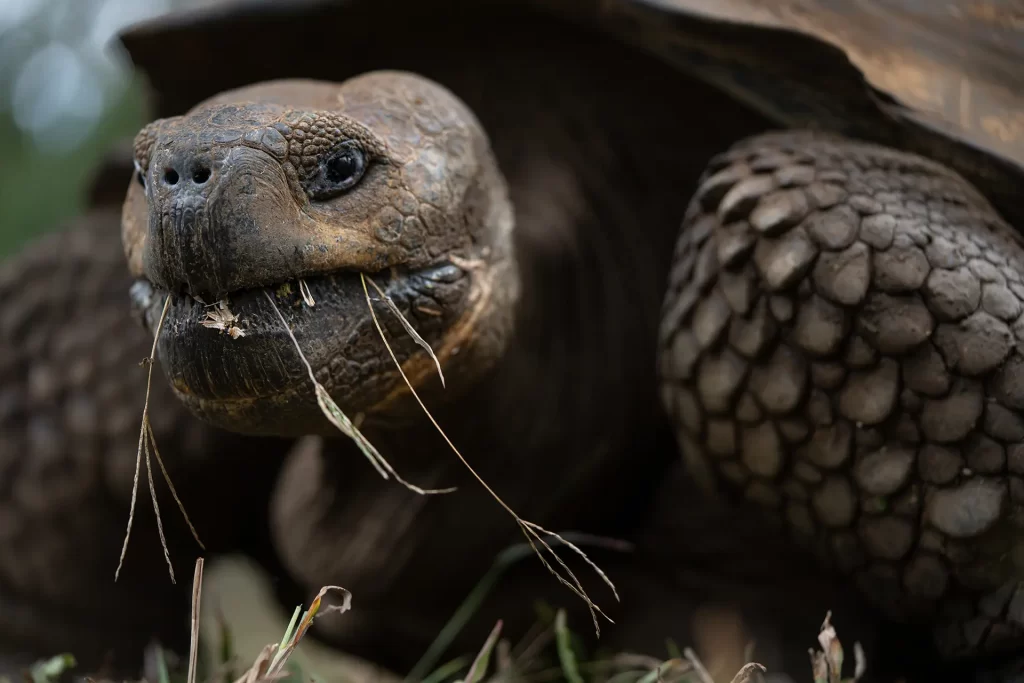
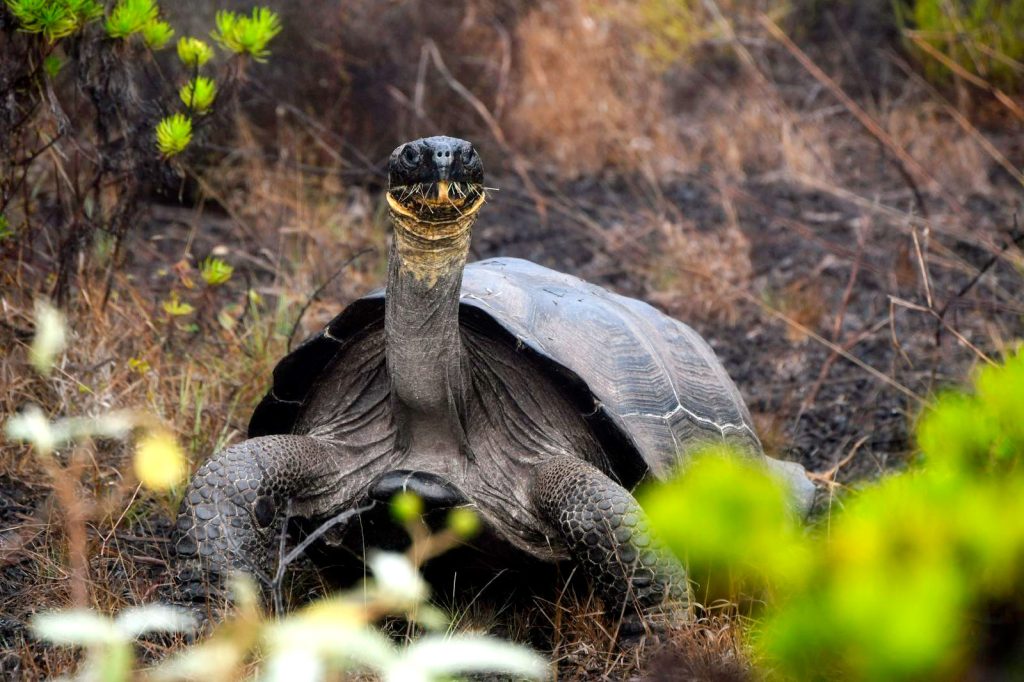
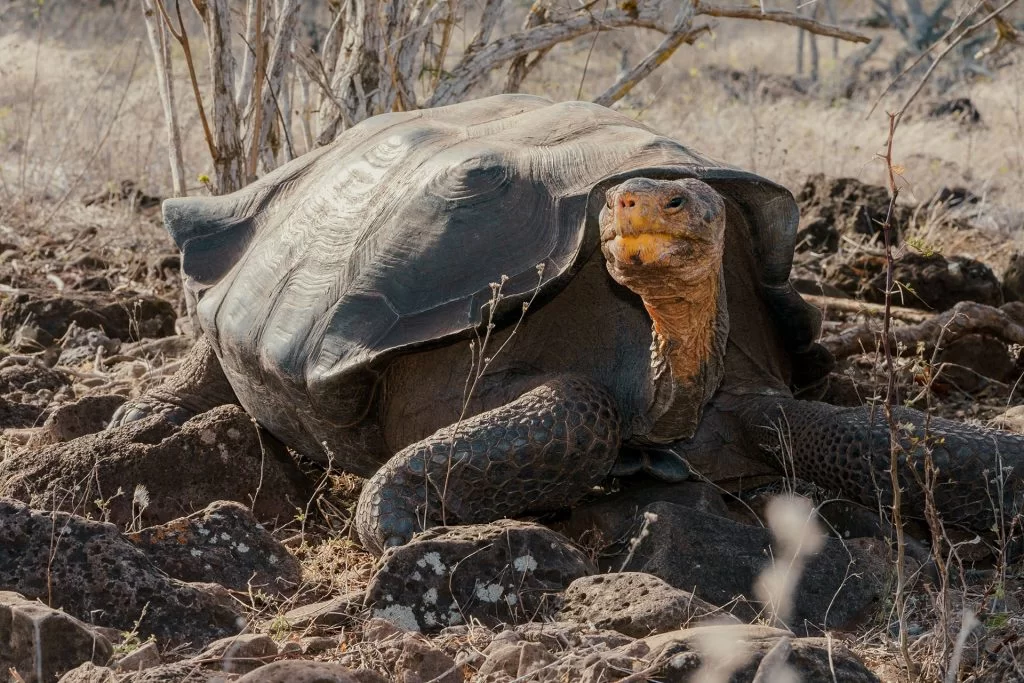
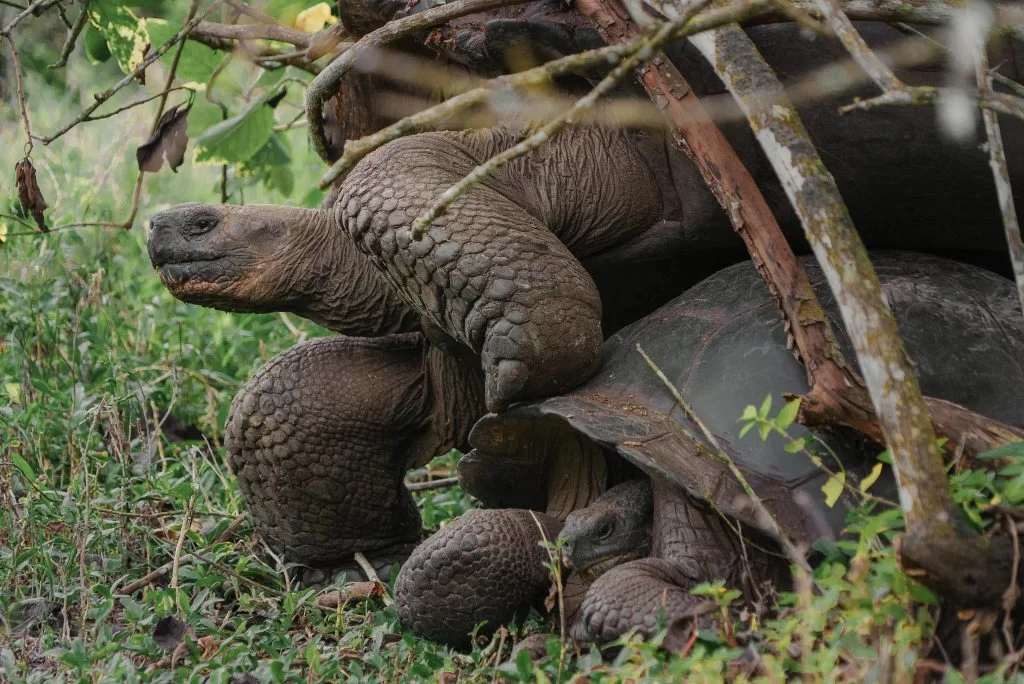
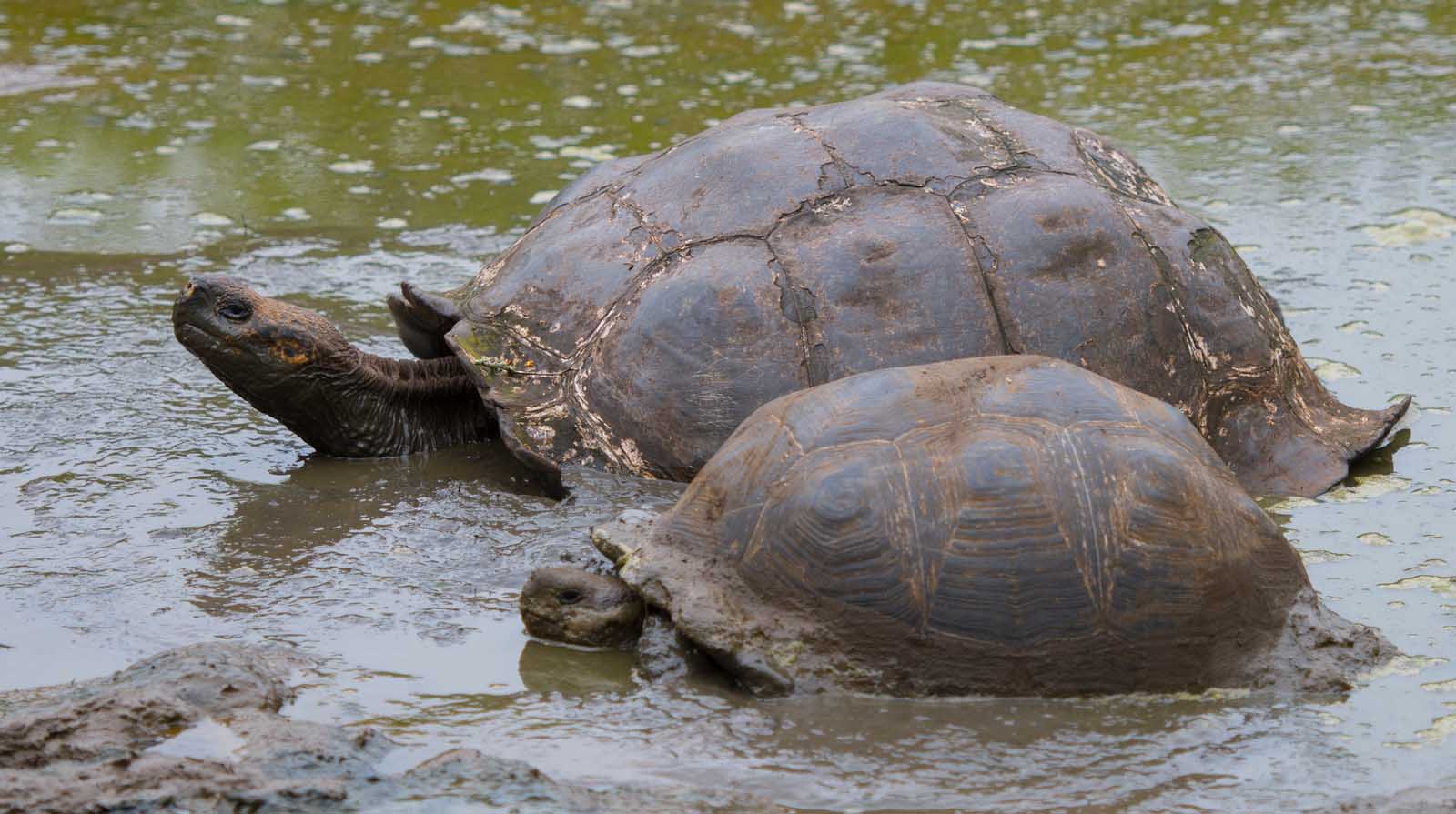
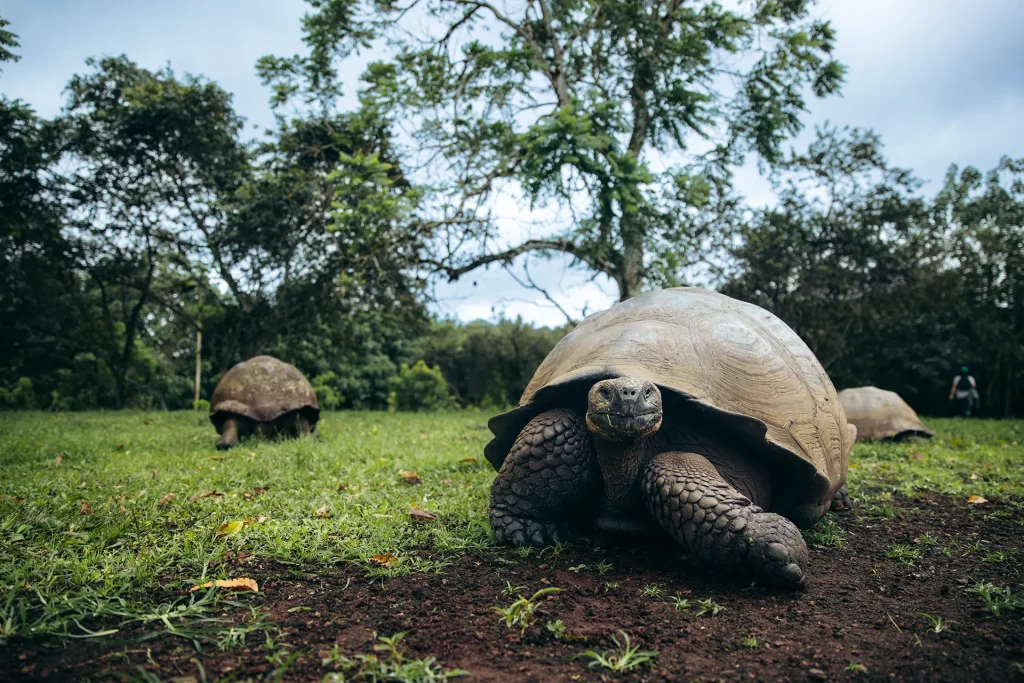
⬛ WEBMASTER DESIGN NOTE: GALLERY — CDRS/PNG archival photos: Lonesome George at full extension, Super Diego in enclosure, El Chato wild tortoises in highland pasture, Fausto Llerena Breeding Center hatchlings, domed vs. saddleback side-by-side comparison. Render as a 5-image responsive grid (lightbox on click); each image 800×450px min. Request image usage rights via CDRS communications office.
⚠️ WEBMASTER: Do not publish until verified — GALLERY images not yet licensed — secure CDRS/PNG archival photography usage rights via CDRS communications office before publishing.
Conservation: From Near-Extinction to Partial Recovery
Before 1535 — before the Spanish galleons, before the whalers, before any of it — somewhere between 200,000 and 300,000 giant tortoises occupied these islands. Then sailors discovered something inconvenient: a tortoise could be stored alive in a ship’s hold for up to a year. It needed no food and no water in storage, just space in the hold, and stayed alive across months of open ocean. Tens of thousands were taken during the 18th and 19th centuries. By the standards of the time, the hunt wasn’t considered cruel — the scale of it took more than a century to become visible.
When direct hunting finally declined, the damage kept coming through a different mechanism. Rats ate tortoise eggs. Pigs tore up nesting sites. Goats, released on island after island over centuries, ate everything else. On Pinta, 40,000 of them stripped the vegetation down to nothing, finishing what the whalers had started. On northern Isabela, introduced goat populations eventually numbered in the hundreds of thousands. If you consider their evolutionary history, the tortoises had no behavioral response to any of it — these were animals that had simply never encountered goats, rats, or sailors in all the time they’d been on these islands.
Between 15,000 and 25,000 individuals, depending on the survey year and methodology — that’s where things stand now, and it represents partial recovery at best. But it didn’t happen by accident. Conservation efforts at the Charles Darwin Research Station, running since the captive breeding programs were established in 1965 in partnership with the Galápagos National Park Directorate, drove most of what’s been possible. Española is the clearest measure of what sustained intervention can do: fourteen individuals in the 1960s, program closed in 2020 with more than 3,000 tortoises on the island. Santiago, Pinzón, and San Cristóbal populations have all grown through similar programs.
Project Isabela, completed in the early 2000s, removed more than 100,000 goats from northern Isabela — one of the largest invasive-species removal operations ever attempted anywhere. Tortoise populations on those volcanic slopes responded. Nest protection programs, rat eradication campaigns, and ongoing habitat restoration continue across the archipelago. There is still a long way to go on several of the more vulnerable populations.
DIRECT TRAVELER | VOYAGERS TRAVEL COMPANY
See Giant Tortoises in the Wild
The best time to encounter wild giant tortoises at El Chato (Santa Cruz) is November through May, when the animals migrate from the coast to the highlands. A 7–8 day cruise itinerary with a Santa Cruz stop includes guided access to the highland tortoise zone.
Plan a tortoise-focused Galápagos trip with Voyagers Travel Company. Their specialists know El Chato, the breeding centers, and current tortoise activity by season. Consider a luxury expedition cruise with our naturalist guides.
Contact Voyagers Travel Company →
WEIGHT
Up to 417 kg
LENGHT
1.2 - 1.5 m
LIFESPAN
150 - 200 years
TRAVEL AGENT / TRADE | LATIN TRAILS (DMC partner)
Group & Research Programs
Latin Trails runs wildlife-focused private expeditions for tour operators, research groups, and photographers. El Chato access, Darwin Station visits, and multi-island tortoise itineraries available at trade rates.
Contact Latin Trails →
WEIGHT
250 - 400 kg
LENGHT
1.2 - 1.5 m
LIFESPAN
150 - 200 years
Where to See Galápagos Giant Tortoises
Santa Cruz — El Chato Tortoise Reserve
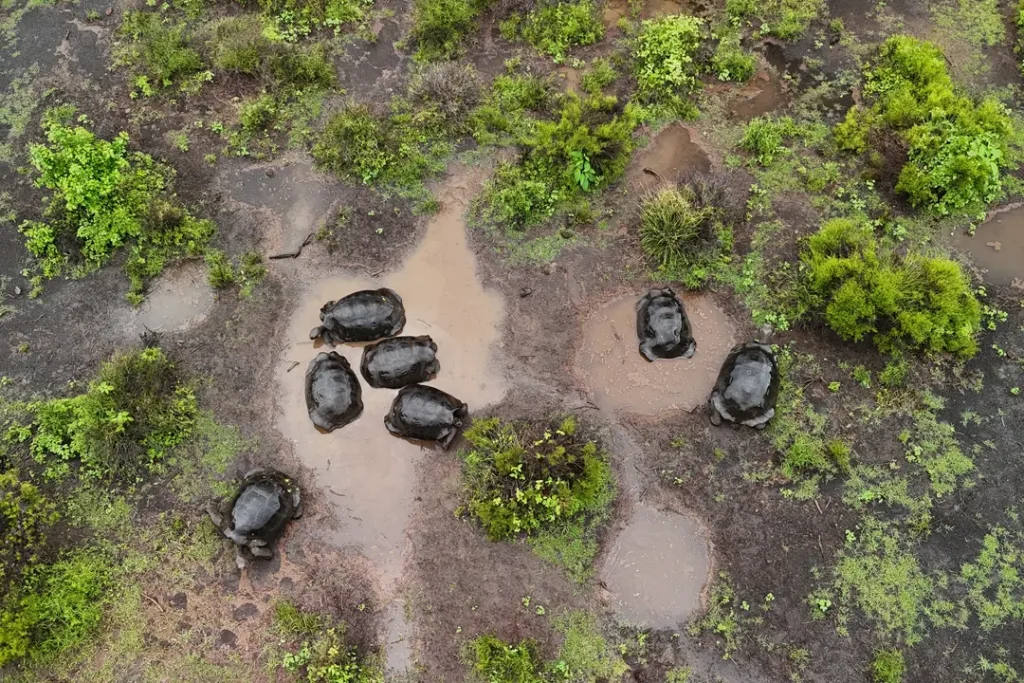
Santa Cruz, El Chato sits in the agricultural highlands, roughly 45 minutes from Puerto Ayora by truck or taxi — past farmland and lava fields and the kind of green that surprises people who expect the Galápagos to be uniformly volcanic and sparse. It’s not sparse up here. The reserve is open: low grass, muddy pools, old-growth Scalesia trees, and tortoises moving through all of it on their own schedule. Some mornings you’ll count forty tortoises before you reach the second field. Other days, eight or ten — mostly half-submerged in mud wallows you almost miss until something shifts. Either number is fine, frankly. The animals aren’t performing for anyone; they’re on land they’ve been crossing for thousands of years, and your arrival doesn’t change much about their morning.
Santa Cruz — Fausto Llerena Breeding Center (CDRS, Puerto Ayora)
What you notice first at Fausto Llerena are the incubation chambers — shoebox-sized, each holding hatchlings at various stages. Juveniles of several subspecies occupy open outdoor pens, moving with that already-recognizable tortoise deliberateness even at the size of a dinner plate. Follow the La Ruta de la Tortuga trail to its end and you reach the Symbol of Hope Hall: Lonesome George, preserved and mounted at full extension behind UV-protective acrylic in a climate-controlled chamber. Open daily 8:00–18:00. You might consider combining this with a morning visit to El Chato if you can manage it — the wild encounter and the conservation story sit differently in the mind when you’ve seen both on the same day. You’ll generally spend two to three hours here without feeling rushed.
Isabela — Arnaldo Tupiza Tortoise Center (Puerto Villamil)
Puerto Villamil doesn’t get the visitor numbers that Puerto Ayora does, and that shows at the Arnaldo Tupiza center. Unhurried, from the moment you walk in. It focuses on Isabela’s tortoise species — Cerro Azul individuals — and it’s close enough to the waterfront that you can walk there from town in ten minutes, which in itself tells you something about the scale of the place. Quieter than Santa Cruz. Worth the slower morning it requires.
San Cristóbal — Galapaguera de Cerro Colorado
About 24 kilometers from Puerto Baquerizo Moreno, up into the San Cristóbal highlands, the Galapaguera de Cerro Colorado functions as both reserve and breeding center for Chelonoidis chathamensis — the San Cristóbal subspecies, whose wild population now exceeds 6,000. A trail cuts through semi-wild habitat where tortoises graze in open view, unhurried and close enough that you notice the individual scratches on their shells, the particular damp smell of them in the highland air, the way they ignore you entirely unless you get directly between them and wherever they were heading.
Best Timing
Both seasons work, and the choice is more about what kind of experience you want than which one is objectively better.
Garúa season runs June through December. Cool mist settles into the Santa Cruz highlands most mornings, cloud cover keeps the temperature down, and the vegetation stays green through what is technically the dry period. Adult tortoises concentrate at higher elevations — El Chato becomes productive, with animals grazing through fog that gives the whole landscape a strange, muffled quality. January through May, the temperature rises, the lowlands green up, and adults begin moving back down toward the coast. Lowland sightings increase; the highland numbers thin slightly. Garúa season tends to produce more tortoises in the highland reserve per visit. But the warm season adds something different: the possibility of watching the actual migration — tortoises in transit, moving at that unhurried 200–300-meter-per-day pace along routes worn into the volcanic rock over thousands of years. More on [INTERNAL LINK: planning your visit → /planning/best-time-to-visit/].
What the Encounter Is Actually Like
You smell them first. It’s earthy and organic — mud, wet vegetation, large reptile — and it becomes, after a few hours in the field, oddly familiar. Then you hear them: the low exhalation of a tortoise surfacing from a wallow, the methodical tearing of grass close to the ground, or occasionally — from somewhere across the pasture — the low grunting call of a mating male. That sound carries further than you’d expect. It sounds nothing like what you’d imagine a reptile producing.
Then you see one. Your brain initially reads the large domed shape as a rock — registers it as landscape, not animal — until it shifts. One slow movement, and then you’re looking at something that has apparently been there for some time.
People are consistently caught off guard by the scale. You’re looking at his neck, not down at his shell — that’s how tall a large Santa Cruz male stands. He walks with a mechanical, entirely unhurried precision, each foot placed deliberately on ground his ancestors crossed for generations. When he grazes, it’s systematic — a slow, clean strip of grass that leaves bare earth behind him, moving forward by increments so small you don’t notice the progress until you look at where he started. He doesn’t hurry. Doesn’t acknowledge you. You’ll find that the encounter runs on tortoise time, and sitting in a field watching one eat for forty-five minutes does something to your own sense of pace that’s fairly hard to explain until you’ve done it.
Santa Cruz: Chelonoidis porteri
Domed, large-bodied, and the species most visitors will actually encounter. An estimated 3,400 individuals live on the western part of Santa Cruz — many in the agricultural highlands, where tortoise paths and ranch fences have coexisted for over a century. Tortoises were there first. El Chato Reserve is, in my experience, the best place in the entire archipelago to observe them moving freely in something close to their natural state: no fences, no feeding, no curation of any kind, just tortoises on a landscape they have shaped across a very long time.
Isabela: Five Species, One Island
Isabela is the largest island in the Galápagos and the only one hosting five separate tortoise species — one per volcano, each separated from the others by lava fields tortoises do not readily cross. Wolf Volcano (C. becki) holds several thousand individuals. Alcedo (C. vandenburghi) holds approximately 6,300 — the largest single wild population in the archipelago. Sierra Negra hosts C. guntheri, Darwin Volcano hosts C. microphyes, and Cerro Azul hosts C. vicina. In effect, the volcanic geography of Isabela created five separate evolutionary experiments within a single island — and all five are still running. See the Isabela Island guide for more.
Tortoise Behavior: What to Watch For
Thermoregulation
Get to El Chato before 9 a.m. if you can. Early morning is when the tortoises are most visibly active — out in the open, oriented to maximize their shell’s exposure to whatever sun is breaking through the cloud cover. They’re loading thermal energy for the day. By midday they drift toward shade or water, and the pastures quiet down. Between 7 and 10 a.m. is when you see them moving, grazing, posturing — the whole behavioral range, not just a large dome sitting still in the grass.
Mud Wallowing
Muddy pools at El Chato always have tortoises in them. A large adult will submerge to the shell rim and stay there — sometimes for hours — while yellow warblers pick ticks from the creases of their skin. It regulates body temperature, and likely reduces parasite load. What it definitely does is make the tortoise entirely indifferent to observers, which is why the wallow pools produce some of the best close-observation opportunities on the island. You stand there watching a large reptile soak in a muddy pool in the Galápagos highlands, yellow warblers hopping across its shell, and if you give yourself a moment to stop counting species, it’s a fairly absorbing thing to watch.
Mating Behavior
Males settle dominance through shell-ramming and neck extension — raising the head as high as possible to appear larger than whoever is standing next to them. Watch for the slow-motion posturing; two males facing off is a display that moves so deliberately it takes a moment to register as a confrontation. Mating call is something else entirely: a series of prolonged, resonant grunts produced by the male, audible across a surprisingly wide distance. Hearing it for the first time across a fog-damp highland pasture — with no obvious source visible — takes a moment. It carries further than distance should allow, and locating it requires standing still long enough that the tortoises stop noticing you.
Seasonal Migration
On Santa Cruz and Isabela, adult tortoises — primarily males over 20 years old, along with some females — make seasonal circuits between highland and lowland zones. That trek covers roughly 6 kilometers, spread over two to three weeks, at approximately 200 to 300 meters per day. These routes are worn into volcanic terrain over thousands of years, tracking gradients of temperature and food availability — not by reasoning, but by instinct repeated across more generations than anyone has counted. Young tortoises, under 20 years old, generally stay put, parked in whatever zone they settled in while their elders complete a circuit that has been running since before anyone was watching.
Giant tortoises feature on most itineraries that touch Santa Cruz or Isabela. If you’re looking at other species, the wildlife guide covers marine iguanas,blue-footed boobies, and Galápagos penguin with the same depth.
Frequently Asked Questions
Between 15,000 and 25,000, and the number is rising. That’s a fraction of the 200,000 to 300,000 that existed before human contact — but it’s also the result of deliberate, sustained intervention over sixty years. Captive breeding programs at the Charles Darwin Research Station have driven most of the recovery. Española’s subspecies went from 14 individuals in the 1960s to over 3,000 by 2020. That’s not a rounding error — that’s a species pulled back from the edge. (Source: Galápagos National Park, PNG, 2022)
El Chato Highland Reserve on Santa Cruz. No fences, no feeding — tortoises moving freely across open pasture and muddy pools in something close to genuine wild conditions. For the conservation side of the story, the Fausto Llerena Tortoise Breeding Center at the Charles Darwin Research Station (also Santa Cruz) has tortoises in a managed breeding program, including several subspecies, and Lonesome George’s preserved mount at the end of the La Ruta de la Tortuga trail. Isabela Island has wild tortoises on the Alcedo and Wolf volcano slopes, but those are accessible only by multi-day cruise — a different kind of encounter, more remote, fewer people.
Lonesome George was the last known individual of the Pinta Island tortoise subspecies (Chelonoidis abingdonii). A Hungarian scientist discovered him on Pinta in 1971, when the island’s tortoise population was already considered extinct. He was brought to the Charles Darwin Research Station in 1972. For the next four decades, scientists tried to find him a mate — searching zoo collections worldwide, running genetic analysis on candidate females, keeping females from related subspecies in his enclosure. He never successfully reproduced. He died on June 24, 2012, at an estimated age of over 100 years. His preserved body is now on permanent display at the Darwin Station, in the Symbol of Hope Hall at the Fausto Llerena Breeding Center.
150 to 200 years, though exact ages for wild individuals are hard to confirm — these animals were alive before reliable record-keeping reached the islands. Oldest reliably documented individuals reached approximately 150 to 175 years. Lonesome George was estimated at over 100 at his death, which means he’d already lived through most of recorded conservation history by the time anyone started worrying about saving his species.
Plan Your Galápagos Tortoise Encounter
DIRECT TRAVELER | VOYAGERS TRAVEL COMPANY
See Giant Tortoises in the Wild
The best time to encounter wild giant tortoises at El Chato (Santa Cruz) is November through May, when the animals migrate from the coast to the highlands. A 7–8 day cruise itinerary with a Santa Cruz stop includes guided access to the highland tortoise zone.
Plan a tortoise-focused Galápagos trip with Voyagers Travel Company. Their specialists know El Chato, the breeding centers, and current tortoise activity by season. Consider a luxury expedition cruise with our naturalist guides.
Contact Voyagers Travel Company →
WEIGHT
Up to 417 kg
LENGHT
1.2 - 1.5 m
LIFESPAN
150 - 200 years
TRAVEL AGENT / TRADE | LATIN TRAILS (DMC partner)
Group & Research Programs
Latin Trails runs wildlife-focused private expeditions for tour operators, research groups, and photographers. El Chato access, Darwin Station visits, and multi-island tortoise itineraries available at trade rates.
Contact Latin Trails →
WEIGHT
250 - 400 kg
LENGHT
1.2 - 1.5 m
LIFESPAN
150 - 200 years
[H2]
Plan Your Galápagos Tortoise Encounter
⬛ WEBMASTER DESIGN NOTE: This card uses the species-card layout — full-width image (16:9 ratio, 800×450px recommended) at top, H3 title below, body text, then stats row (3 columns: weight | length | lifespan). See UX Blueprints doc for card CSS.
CTA: Direct Traveler | Voyagers Travel Company Ready to see giant tortoises in the wild? Voyagers Travel Company specializes in Galápagos island experiences — from highland tortoise encounters at El Chato to multi-island cruise itineraries with guided breeding center visits. |
⬛ WEBMASTER DESIGN NOTE: This card uses the species-card layout — full-width image (16:9 ratio, 800×450px recommended) at top, H3 title below, body text, then stats row. See UX Blueprints doc for card CSS. NOTE: Latin Trails appears here only as the trade-channel DMC partner — never as co-publisher or data source.
CTA: Travel Agent / Trade | Latin Trails (DMC partner) Tour operators, wholesalers & research groups Latin Trails is the local DMC partner for wildlife-focused itineraries. Trade rates, custom multi-island tortoise programs, and research logistics available. Request a quote for your next group. |
Explore Galápagos Wildlife
| Wildlife Guides |
|---|
| Iconic Species & Places |
|---|
| Plan Your Trip |
|---|