
Plan your trip
Get a custom Galápagos itinerary
When is the best time to visit the Galápagos? The Galápagos Islands have two seasons: warm and wet (December–May) and cool and dry (June–November). No bad time to visit. Whale sharks appear June–November and peak August–September at Darwin and Wolf. Giant tortoises nest October–February. Waved albatross occupy Española April–December. Water ranges 19–24°C cool season, 23–26°C warm season.
Travelers ask me this every week. The honest answer is: it depends on what you are chasing.
If you want whale sharks, you fly in August. If you want baby sea lions wobbling on the beach at Loberia, you fly in February. If you want quiet trails and lower prices, you fly in November. You will not find a single best month for everyone, and any article that promises one is selling you the month they have empty cabins to fill.
So here is what twenty years of guiding has taught me, broken down month by month, with the species behavior I actually witness in the field. Skim the table. Read the months that matter to you. Skip the rest. But come back to this page when you start narrowing dates, because the difference between June 28 and July 10 is not nothing.
You should understand one thing before anything else. Galápagos has two seasons, and the difference between them is driven by ocean currents, not by latitude or sunshine. Get the currents right in your head and the rest of the calendar makes sense.
Humboldt Current pushes cold, nutrient-rich water up from the south, climbing along the western coast of Isabela and wrapping the central islands in upwelling that carries plankton, fish, and the predators that follow them across the equator. Air drops into the low 20s Celsius. Seas turn choppier. A mist called garúa hangs in the highlands most mornings.
But the ocean comes alive. Whale sharks arrive at Darwin and Wolf. Hammerheads school in numbers you will not see anywhere else on Earth. Galápagos penguins fish aggressively, waved albatross occupy their colony on Española, and marine biomass is, by every measure I have ever read or witnessed in the field, the highest of the year.
Water sits at 19–22°C at most central island sites. Up north at Darwin and Wolf, it can run 22–24°C, but currents can be powerful enough that even experienced divers hold on to the rocky walls during the safety stop to avoid being swept away from the boat’s pickup zone. Bring a 5mm wetsuit if you plan to dive seriously.
Warm Panama Current dominates. Water climbs to 23–26°C across most sites. Skies turn brighter, with short tropical showers that pass in an hour. Vegetation explodes green. You will feel like you are visiting a different archipelago entirely from the one a July diver describes to you over dinner six months later.
You will find this is the family season, the first-snorkeler season, the season for travelers who would rather not wear a thick wetsuit. Visibility underwater is excellent, often 25 to 30 meters. Baby sea lions, marine iguana nesting, and warm calm seas make for the easiest entry into the islands’ wildlife that I know how to recommend.
These are the in-between weeks when currents are switching. May offers warm water and the first hammerhead aggregations. June begins the cool season, but seas are still relatively calm. November shoulder season is one of my personal favorites: warming water, tortoise hatching season, low crowds, often the best pricing of the year. But ask your operator about specific dates, because the changeover can shift two or three weeks year to year.
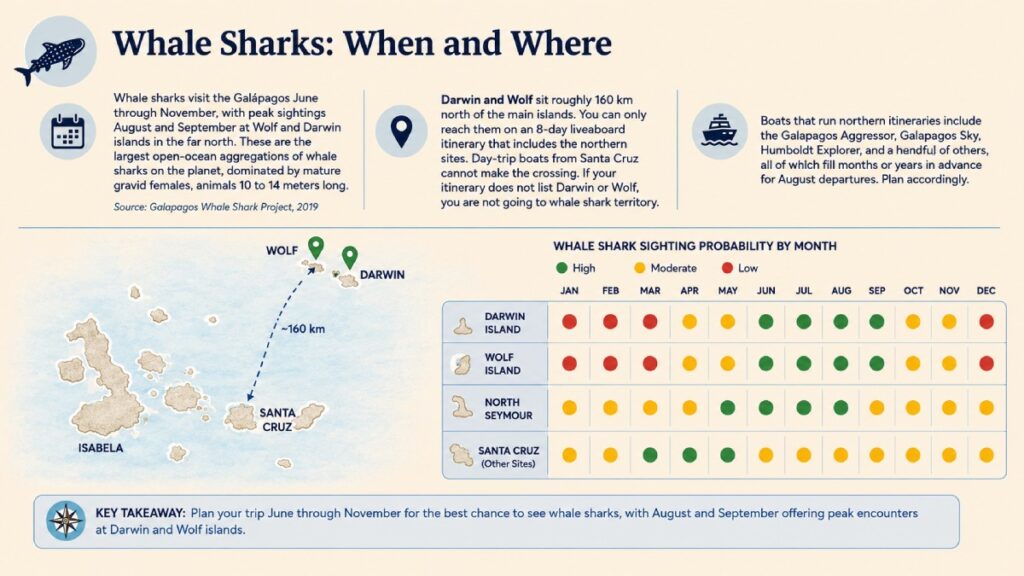
Whale sharks visit the Galápagos June through November, with peak sightings August and September at Wolf and Darwin islands in the far north. These are the largest open-ocean aggregations of whale sharks on the planet, dominated by mature gravid females, animals 10 to 14 meters long. Source: Galapagos Whale Shark Project, 2019 published data.
Darwin and Wolf sit roughly 160 km north of the main islands. You can only reach them on an 8-day liveaboard itinerary that includes the northern sites. Day-trip boats from Santa Cruz cannot make the crossing. If your itinerary does not list Darwin or Wolf, you are not going to whale shark territory.
Boats that run northern itineraries include the Galapagos Aggressor, Galapagos Sky, Humboldt Explorer, and a handful of others, all of which fill months or years in advance for August departures. Plan accordingly.
“Darwin Island is the only place I have been underwater and had to count whale sharks because I stopped being able to track individuals. Twenty-three on one dive is the number I remember.”
— Juan Magallanes, Naturalist Expert Contributor, GalapagosIslands.travel
View full ↗Female tortoises in the Santa Cruz highlands begin moving toward nesting areas in October, sometimes walking for days at the deliberate pace that gave them their name, leaving wide drag-tracks in the volcanic soil that look like someone hauled a small boat through the bush. They dig nest chambers in dry soil, lay between 4 and 16 eggs, cover the chamber, and leave. Eggs incubate underground for around four months.
Hatchlings emerge between January and April. They weigh about 50 grams and look exactly like the adults will look, scaled down to the size of a tennis ball, complete with the slow blink and the patient turn-of-the-head that suggests they have already inherited the geological time-sense their species is famous for. You can walk the highland trails during hatching season and have a small chance of spotting one. It is rare. But it is also one of the most quietly profound things I show clients.
If you are visiting outside hatching season, the Charles Darwin Research Station on Santa Cruz and the Arnaldo Tupiza Center on Isabela display tortoises year-round, including juveniles in the breeding program. Year-round tortoise viewing is straightforward; wild hatchlings are a window.
Best months: July through November. Cooler water, sharper visibility, peak large pelagic activity. Hammerheads aggregate year-round at Wolf, Darwin, Gordon Rocks, and Roca Redonda. But school sizes are largest in the cool season.
You can expect visibility of 25 to 30 meters when conditions cooperate. Water temperatures run 18 to 22°C across the cool season. A 5mm wetsuit is standard. A 7mm or drysuit if you are sensitive to cold or planning multiple long dives per day at Darwin.
Manta rays are present September through February. Galápagos sharks year-round. Mola mola (sunfish) are most reliable June through November at deeper sites including Punta Vicente Roca, where the deep cold upwelling brings these strange disc-shaped fish to within recreational depth ranges for a few precious dives each year. Diving in the Galápagos requires a certified divemaster and a GNPS-licensed liveaboard or day-boat operator. There is no independent shore diving inside the marine reserve.
Warm season is the family season. January through May means warmer water for snorkeling, calmer seas for kids who get queasy, and the easiest wildlife encounters. Baby sea lions, born December through February, are the standout family experience: curious, playful, and entirely unafraid.
You will find marine iguana nesting mesmerizing for children: black dragons digging into the sand, snorting salt water from their nostrils, looking exactly like miniature dinosaurs because they basically are. Highland tortoise reserves are easy walks suitable for kids 5 and up.
Park rules apply to everyone regardless of age. The 2-meter wildlife distance rule, the no-touching rule, the stay-on-the-trail rule: brief your children before you arrive at the visitor site, not at the visitor site itself, because a child who learns the rule from the guide ten seconds before encountering a sea lion has not learned the rule, only the embarrassment of being corrected in public. Guides will reinforce these rules, and children almost always rise to the moment when they understand the why.
Peak: July and August (whale sharks plus northern hemisphere summer holidays), plus the last two weeks of December. Shoulder: May, June, September, and October. Low: late January through early March and most of November.
Prices on the same cabin can swing 25 to 40 percent between peak August and low November on identical itineraries. Wildlife in November is not worse than wildlife in August. But it is different. If your budget matters and you are not chasing whale sharks specifically, the value months are where the smart bookings happen.
Book 9 to 12 months ahead for peak departures, especially if you want a specific cabin category on a specific vessel for a specific itinerary that includes Darwin and Wolf in August, because that exact combination is one of the most popular and most constrained inventory items in the entire wildlife travel industry. Book 3 to 6 months ahead for shoulder and low season. Last-minute deals exist but the best cabins on the best vessels are usually gone.
Get a custom Galápagos itinerary
Wholesale rates for agents
Yes, but not in the way you are picturing. The warm season, December through May, brings short tropical showers that usually last an hour. Rain almost never ruins a day. March is the rainiest month at around 8 cm total. The cool season is technically dry, but a misty drizzle called garúa hangs in the highlands most mornings.
June through November, peaking in August and September at Wolf and Darwin islands in the far north of the archipelago. You can only reach those sites on an 8-day liveaboard. Day boats from Santa Cruz do not go that far north.
Around 19°C (66°F) on average across the central islands. Slightly warmer at Wolf and Darwin in the north, sometimes reaching 22°C. August is the coldest month for water and is exactly why marine life is at its peak.
Yes. Wild tortoises live in the Santa Cruz highlands, Isabela, and several other islands, and you can see them on a guided highland visit any month of the year. Hatchlings only emerge January through April. Captive breeding centers display tortoises year-round, including juveniles.
January through May. Warmer water, calmer seas, baby sea lions on the beaches, and lush green landscapes that photograph beautifully. Avoid late July through early August if you can: that is peak crowd season and water is at its coldest.
Both are good but different. June is the start of cool season, the seas are still mild, and the first whale sharks are arriving. July sees larger school activity, rougher seas, and more divers. If you want the action without the maximum crowds, June. If you want peak biomass, July or August.
Book late January, February, or November for the same cabin on the same vessel at a 25 to 40 percent discount versus August. Wildlife is excellent in those months, just different from peak whale shark season. Avoid the last two weeks of December, which is the most expensive period of the year.
Yes. Española hosts the waved albatross colony April through December, then the entire colony leaves for the open ocean. Fernandina has marine iguana nesting January through March. Genovesa is bird-rich year-round. Darwin and Wolf are whale shark territory June through November. A good itinerary matches your travel month to the right islands.
The Galápagos whale shark season runs June through November, peaking August and September at Darwin and Wolf islands. Giant tortoises nest October through February with hatchings January through April. Water temperature ranges from 18°C (cool season, August low) to 26°C (warm season, February–April high). Source: Juan Magallanes field observations, Charles Darwin Foundation (CDF); Galapagos Whale Shark Project; Charles Darwin Foundation seasonal reports.
[VIDEO: topic — 90-second Juan voice-over on seasonal differences, embedded after “The Two Seasons”]
Our Galapagos specialists are here to help you plan the perfect adventure.