
Galápagos Entry Requirements: What You Actually Need

By Juan Magallanes, Naturalist Expert Contributor — Voyagers Travel Company

What permits does a tourist need to visit Galápagos?
A Transit Control Card (TCT), currently USD $20 per person, registered online before your domestic flight. A National Park entrance fee, currently USD $200 for foreign adults, USD $100 for children under 12, USD $100 for citizens of CAN/Mercosur countries, and USD $30 for Ecuadorian nationals, paid in cash on arrival at Baltra (GPS) or San Cristóbal (SCY). No tourist visa is required for most nationalities for stays under 90 days.

Travelers ask me about paperwork more than almost anything else. Good. You should ask. Two decades of guiding has taught me that the people who arrive prepared, who understand the small bureaucratic moments before they happen, are the people who relax fastest once they step onto the boat or into the highlands and realize they have arrived in a place that does not quite resemble anywhere else.

You need two things. A Transit Control Card, and the National Park fee on arrival. Beyond that, most travelers need only their passport, a return ticket, and the small habit of reading the email your operator sends you the week before departure, because the rules have changed twice in the last two years and the guidebook on your shelf is almost certainly out of date.

The Transit Control Card (TCT)

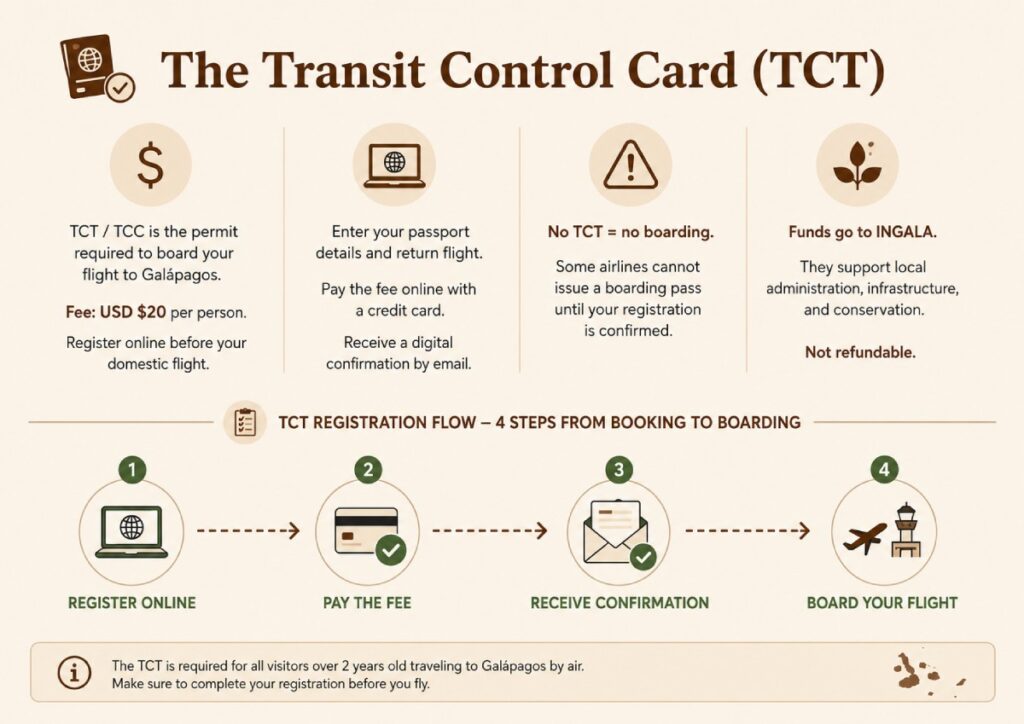
Your Transit Control Card, often called the TCT or TCC, is the permit that lets you board a flight to the islands. It costs USD $20 per person. As of May 2025 it is registered through an official online portal before your domestic flight, not at the airport counter the way it used to be.

You register with passport details and your return flight, paying the USD $20 fee with a credit card, and the portal issues a digital confirmation that links automatically to the airline manifest used for the Galápagos route. You receive a copy by email. Print it. Or do not. The airline still checks the system regardless.

If you do not have a TCT, you cannot board. Some airlines will not even issue a boarding pass without the registration confirmed in their system. I have watched travelers miss a cruise over a missing TCT, and I do not want that to be you.

Funds collected go to INGALA, the Galápagos Special Regime Governing Council, and pay for local administration, infrastructure, and conservation programs across the four inhabited islands. Not refundable.

The Transit Control Card (TCT)View full ↗

National Park Entrance Fee

Here is the second fee, separate from the TCT. You pay it on arrival, at the airport counter, before you exit into baggage claim. But the amounts changed in August 2024 for the first time in 26 years, so old guidebooks lie to you.

Visitor Category Fee (USD)
Foreign adult (12+) $200
Foreign child (under 12) $100
CAN / Mercosur adult $100
CAN / Mercosur child $50
Ecuadorian national (12+) $30
Ecuadorian child $15
Infants under 2 Free

Pay in cash if you can. Card readers exist at the counter, but they fail often, and there is no second window if yours rejects. Bring crisp USD bills, no rips, no scribbles. Ecuador uses the US dollar as its official currency, and damaged bills are routinely refused even at banks.

Fees can be revised by the Galápagos National Park Directorate. Verify before you fly. Source: gobiernogalapagos.gob.ec and Galapagos Conservation Trust briefing, 2024.

Flight Rules: You Can Only Fly Through Quito or Guayaquil

Every flight to the islands departs from mainland Ecuador. No exceptions. No international direct flights exist. You fly into Quito (Mariscal Sucre, UIO) or Guayaquil (José Joaquín de Olmedo, GYE), spend at least one night on the mainland in most reasonable itineraries to absorb the time-zone shift, and only then connect to the morning domestic flight that lands in the archipelago around midday.

Two airports receive flights in the islands: Baltra (GPS) near Santa Cruz, and San Cristóbal (SCY). Your cruise itinerary or hotel package tells you which one. Mix them up and you are on the wrong island, an hour and a ferry from where you should be.

If you are booked on a specific liveaboard, check the operator’s flight policy. Some vessels, including the Hermes Catamaran and the Ocean Spray, require flights to be booked through them on a group fare. But showing up on a different flight, even a more expensive one, can mean missing the briefing window and the airport transfer.

Your tour operator books these flights as part of the package for every traveler on our itineraries. You do not have to figure out the timing, the gate logistics, or the airline reseat rules. We handle it.

What You Cannot Bring

Tourism is not the biggest threat to Galápagos wildlife. Invasive species are: seeds, insects, fungi, anything that did not evolve here. Galápagos Biosecurity Agency (ABG) inspectors check every bag on arrival, with no exceptions.

You cannot bring fresh fruit, vegetables, seeds, live plants, or animals of any kind. Wood products and dairy face scrutiny too. Dogs work the line. They flag a bag, the inspector opens it, and whatever set the dog off goes into a sealed bin without ceremony.

Pack what you would take on any tropical trip: sunscreen, reef-safe if you can get it, light clothes, layers for cool-season evenings, a good camera, a refillable water bottle, decent walking shoes for lava terrain, and a dry bag for boat days. Skip the trail mix with seeds. Skip the apple from the hotel breakfast buffet that you stuffed in your daypack at 5am.

If you are unsure, ask at check-in. Inspectors are friendly when you are honest about what is in your bag.

How Long Can You Stay?

Most nationalities receive 90 days on arrival in Ecuador as a tourist, and Galápagos counts inside that window. No separate visa exists for the islands themselves. Some passports, including Cuba and several African and Asian countries, receive less or require advance approval. Check with an Ecuadorian consulate if you are unsure.

Inside the islands, no maximum stay applies to organized tourism. You can take a 4-day cruise, a 5-day cruise, an 8-day cruise, or stack land-based itineraries back to back. Residential zones where Galápagos citizens live are governed separately. But as a tourist you do not live there, you visit.

Liveaboard cruises run fixed itineraries: typically 4, 5, or 8 days. You join on day one and disembark on the final day, with the cabin assigned, the route locked, and the next group already waiting in Quito for the same flight you came in on. No extending mid-cruise.

Visa Requirements

Most North American, European, UK, Australian, New Zealand, and Japanese passport holders enter Ecuador visa-free for up to 90 days, which is more than enough time for almost any combination of cruise, land tour, and mainland extension that a first-time visitor is likely to plan. Bring a passport with at least six months of remaining validity. That is the threshold every airline enforces.

Citizens of most South American countries enter visa-free as well. Some African, Asian, and Middle Eastern nationalities require a tourist visa in advance. Ecuador’s Ministry of Foreign Affairs publishes the current list, and you should check before you book flights.

If you need a visa, apply at the Ecuadorian consulate in your country. Processing takes two to six weeks in most jurisdictions. But do not leave this to the last month, because consular calendars fill up in high season and a denied entry stamp is permanent.

What About Children?

Children under 12 pay USD $100 for the park fee, exactly half the adult rate, and the same proof of identity is required regardless of age, so a passport for every minor is mandatory and a hospital birth certificate is not a substitute. Infants under 2 enter free.

If a minor travels with only one parent, or with neither parent, Ecuador requires a notarized travel authorization from the absent parent or legal guardian. Translate it into Spanish if the original is in another language. Immigration checks this on entry to Ecuador, not just at the Galápagos counter.

Bring the original. A phone photo will not be accepted. Skip this step and your child can be denied boarding on the domestic flight, which is the worst possible moment to discover a paperwork problem because you have a cruise that leaves Baltra at noon and no second chance to fix it from Quito.

Booking With a Licensed Operator

Galápagos tourism is regulated. You can walk around the four populated towns, Puerto Ayora on Santa Cruz, Puerto Baquerizo Moreno on San Cristóbal, Puerto Villamil on Isabela, and Puerto Velasco Ibarra on Floreana, without a guide. But step into any protected visitor site and you need a GNPS-certified naturalist.

This is not bureaucracy for its own sake. Visitor sites are fragile, the wildlife is bold and unafraid, and rules exist so that the experience your grandchildren have inside the Charles Darwin Foundation’s protected boundary is the same one you are about to have on your trip this week. A licensed guide knows the trail, the species, the distance, and the season. They also know when something is wrong. Then a site rests.

Your operator handles every document for booked travelers: TCT registration, park fee receipts, biosecurity briefings, flight logistics, guide assignment. You arrive, you show your passport, you start your trip.

“The single biggest mistake we see is travelers who arrive at the Galápagos airport without the Transit Control Card. You cannot board the flight without it, and some airlines will not even issue a boarding pass. We brief every traveler before departure.”
— Juan Magallanes, Naturalist Expert Contributor, GalapagosIslands.travel

×

Frequently Asked Questions

Can I buy the Transit Control Card online?

Yes. Since May 2025 the TCT must be registered through the official online portal before your domestic flight. The fee is USD $20 per person. You receive a digital confirmation by email, which the airline verifies at check-in.

Is the National Park fee included in cruise prices?

Almost never. Read the inclusion list carefully. Most cruises and most land tours quote the cruise or hotel portion only. You pay the park fee in cash on arrival at the airport. Some all-inclusive packages do bundle it, so verify before you fly.

What happens if I miss my connecting flight in Quito?

Call your operator first. If you booked through Voyagers Travel or your tour operator, we rebook the domestic leg and notify the cruise vessel. If you booked independently, contact the airline directly. Avianca, LATAM, and Equair operate the Galápagos route and can usually move you to the next available flight.

Do I need travel insurance for Galápagos?

Strongly recommended, often required. Most liveaboard operators require proof of travel insurance that includes emergency evacuation. The islands are remote, the nearest hyperbaric chamber is in Puerto Ayora, and a serious incident may require a flight back to mainland Ecuador. Buy a policy that covers medical evacuation specifically.

Can I bring prescription medication?

Yes. Bring medication in original packaging with the prescription label visible. A copy of the prescription itself is a good backup. Controlled substances should be declared. Do not pack medication in checked luggage. Keep it on your person.

Is there a fee to visit multiple islands?

No additional national park fee for inter-island travel. The single park fee covers your stay. Some specific visitor sites, for example the highlands tortoise reserves on Santa Cruz, charge a separate small site fee paid to the landowner, usually under USD $10.

What currency should I bring?

US dollars. Ecuador uses the US dollar as official currency. Bring small bills: twenties and tens, plus a stack of singles for tips and small purchases. Card payments work in larger restaurants and shops in town but are unreliable at the airport park fee counter.

Can I enter Galápagos on a one-way ticket?

No. Ecuadorian immigration and the airline both require proof of onward travel. Show a return flight or a confirmed onward booking out of Ecuador. The TCT registration also asks for return flight details, and you cannot complete it without them.

As of 2026, visiting the Galápagos Islands requires a Transit Control Card (USD $20) registered online before your domestic Ecuadorian flight, plus a National Park entrance fee (USD $200 for foreign adults) paid in cash on arrival at Baltra or San Cristóbal. All tourism inside protected visitor sites requires a GNPS-licensed naturalist guide. Source: Galápagos National Park Directorate, INGALA.

[GALLERY: source — GalapagosIslands.travel / Juan Magallanes photo archive, 6 images: TCT counter, park fee booth, biosecurity check, baggage inspection, Baltra terminal, naturalist briefing]

[VIDEO: topic — 90-second arrival walkthrough by Juan Magallanes, embedded after H2 “Flight Rules”]