Galapagos Islands with Kids — The Complete Family Travel Guide

By Juan Magallanes, Naturalist Expert Contributor — Voyagers Travel Company

The Galapagos Islands are one of the best family travel destinations on the planet. Wildlife shows no fear of humans — children snorkel with sea lions, observe giant tortoises up close, and watch blue-footed boobies from one metre away. Most cruise operators accept children from age 5. Safety standards are high, activities are constant, and the educational impact is immediate.

Why the Galapagos Works So Well for Families

The Galapagos delivers a wildlife experience that simply does not exist elsewhere, and that singularity matters enormously when traveling with children. Because of two centuries of isolation and strict protection, the animals here have no fear response to humans. A child can sit one metre from a blue-footed boobies on her nest, watch giant tortoises from two metres away, or be investigated underwater by a curious sea lion pup. For the full species rundown, see our wildlife guide.

Galapagos itineraries are also naturally activity-rich. A typical day combines a morning zodiac ride, a mid-morning snorkel, an afternoon hike, and wildlife spotting from the deck at sunset. Children are constantly engaged. The educational payoff is immediate: finch beak variation, tortoise subspecies, marine iguanas sneezing salt — textbook moments seen live. The Charles Darwin Research Station holds the attention of school-age children in a way few museums do. Booking is typically through Galapagos cruises designed for expedition travel.

Unlike an African safari, the Galapagos has no large terrestrial predators, no venomous land animals, and no significant disease vectors. Within National Park rules, children can walk freely in an ecosystem that is genuinely safe.


What Age Is Right for the Galapagos?

Ages 3–5 (Toddlers)
Most cruise operators set a minimum age of 5 for expedition-style itineraries. A handful of operators will permit infants and toddlers on charter vessels where the family books the full boat and controls the daily schedule. The primary challenges for under-5s are real but manageable: motion sickness on zodiac transfers (consult your pediatrician first), sleep disruption from early-morning excursions, and longer hikes — many landing sites involve 1–3 km of walking on uneven volcanic terrain.
Ages 5–12 (Ideal Family Travel Window)
This is the optimal Galapagos age range. Children at this age are mobile enough for every hike, confident enough to snorkel with light guidance, and young enough that the fearless wildlife encounters feel genuinely transformational. Most onboard programs are designed for this group, and children in this window consistently rate the Galapagos among their most memorable travel experiences.
Ages 13–18 (Teenagers)
Teenagers with an interest in photography, marine biology, conservation, or adventure travel typically engage very deeply. Older teens can also participate in liveaboard diving (minimum age for diving varies by operator — typically 10–12 with junior open water certification). Some 4–5 day central-loop itineraries can feel too short for teens; 7–8 day expeditions with more island variety, or land-plus-cruise combinations that include Isabela or the western islands, are strongly recommended.


Best Family-Friendly Cruise Ships

Stability matters: Catamarans are significantly more stable in Galapagos swells than monohull yachts — the single most important factor for families with young or motion-sensitive children.

Compare family cruise options and higher-end luxury expedition yachts before deciding. The categories below match ship type to family profile.

Best for Young Families (Catamaran — Stability + Space)

Hermes Mega Catamaran — 20 passengers, extra-wide deck space, stable platform, private balcony suites, and a dedicated social space that works well when children need downtime.

Ocean Spray — 16 passengers, catamaran, private balconies, Sky Deck jacuzzi. The smaller capacity makes this a good option for families chartering the full vessel.

Best for Older Children and Teens (Activity-Focused)

Endemic — 16 passengers, designed around active excursions, highly regarded naturalist guides, strong snorkeling program. Older children who want more activity and less formality will prefer this style of ship.

Best for Multi-Generational Groups (Larger Capacity)

Galapagos Legend — 100 passengers, expedition ship, most stable in rough weather, multiple lounges and deck areas, doctor on board — a meaningful comfort factor when traveling with elderly grandparents alongside young grandchildren.

Full Charter Option

For families of 8–16 (or families willing to share with one other family), booking a full catamaran charter gives you complete control over the daily schedule, menus, guide focus, and wake-up times. This is the highest-comfort family option in the archipelago. Contact Voyagers Travel Company for charter pricing.

Activity-by-Activity Age Guide (Recommendations)

Use this table as a quick reference when matching a child’s age to the activities they will actually enjoy. Always confirm specifics with your operator — individual ships and itineraries vary.

Activity Min Age Notes
Snorkeling 5+ Wetsuits and small fins available on all ships; guide assistance available
Zodiac transfers 3+ Some swell involved; sit in the middle of the zodiac; Dramamine recommended for motion-sensitive kids
Hiking (flat/short, ≤1 km) 3+ North Seymour trail, Darwin Station, Garrapatero beach trail
Hiking (moderate, 1–3 km) 3+ El Chato highlands, Espanola’s Punta Suarez, North Seymour trail, Tortuga Bay trail
Hiking (difficult, volcanic) 10+ Sierra Negra volcano trail (8 km), Fernandina
Sea kayaking 8+ Must be able to paddle independently; tandem kayaks available
Scuba diving 10+ Junior Open Water Diver certification required; minimum age varies by operator
Glass-bottom boat All ages Available on some ships and day tours

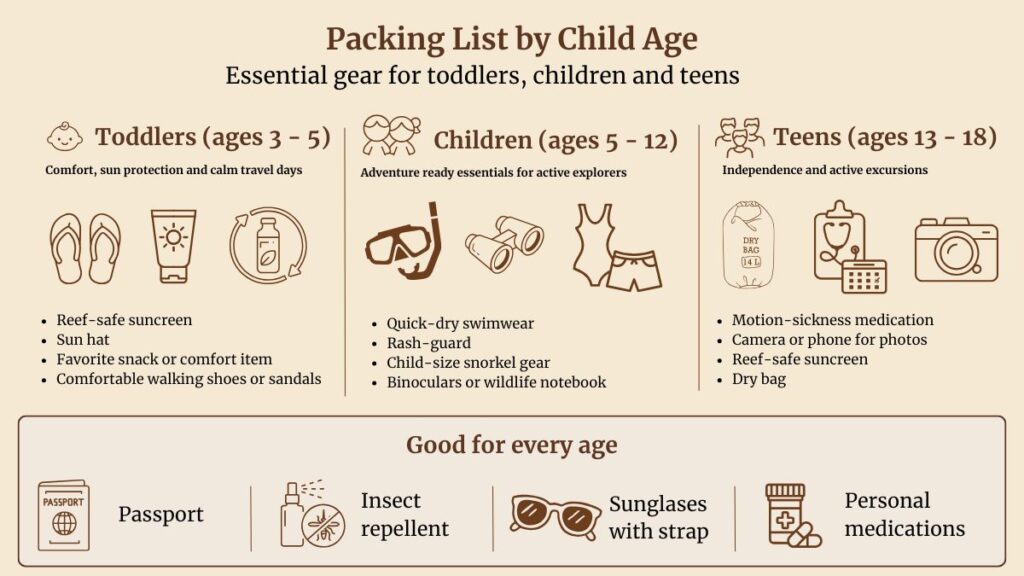
See the full what to pack checklist for a printable version.

Activity-by-Activity Age Guide (Recommendations)View full ↗

Best Islands for Families

Below are the five most family-friendly visitor areas, drawn from across all 13 islands.

1. Santa Cruz — The Charles Darwin Research Station is one of the most child-friendly educational sites in the Galapagos. El Chato tortoise reserve is a walkable, flat, zero-risk wildlife encounter. Tortuga Bay’s calm inner lagoon (Playa Mansa) is safe for children to swim and snorkel. (Santa Cruz)

2. North Seymour — Short trail, maximum wildlife density. Children walk within 1–2 metres of nesting blue-footed boobies and frigatebirds. One of the most reliably impressive short visits in the archipelago.

3. Bartolome — Pinnacle Rock views from the summit (short steep trail, well-maintained wooden steps), Galapagos penguins in the snorkeling area. A strong combination of visual drama and active wildlife.

4. Espanola — Best for older children (8+) who can handle the uneven terrain of Punta Suarez. The waved albatross colony is extraordinary — once seen, not forgotten.

5. Isabela — Best for families combining land and cruise. Tintoreras (white-tipped reef sharks resting in shallow water) and the Las Tintoreras lagoon are accessible half-day trips from Puerto Villamil.

Health, Safety, and Practical Tips

Safety record: The Galapagos is one of the safest wildlife destinations in the world for children — no large terrestrial predators, no venomous land animals, and no significant disease vectors beyond standard tropical sun and hydration precautions.

Motion sickness — The biggest practical concern. Galapagos swells between islands can be significant (2–3 m in the dry season). Catamarans are by far the most stable option. Scopolamine patches (prescription required in most countries) are highly effective; Dramamine/dimenhydrinate works for most children. Bring enough for the full trip — island pharmacies are limited.

Sun protection — Equatorial sun is intense year-round. SPF 50 reef-safe sunscreen is mandatory (conventional sunscreen is restricted in the Marine Reserve). Long-sleeve rash guards are more practical than repeated sunscreen application for children.

Water — All cruise ships provide purified drinking water. Do not drink tap water on the islands. A refillable water bottle per family member is the right answer.

Medical — San Cristóbal hosts the best-equipped hospital in the Galapagos (Hospital Oskar Jandl in Puerto Baquerizo Moreno), while Santa Cruz offers reliable secondary care. Larger expedition cruise ships, such as the Galapagos Legend, carry a dedicated ship’s doctor or medical officer. Travel insurance covering medical evacuation is strongly recommended for every family member.

National Park rules for children — The 2-metre wildlife distancing rule applies to all visitors, including children. Naturalist guides are responsible for enforcement. Feeding or touching wildlife is not permitted under any circumstances. Review entry requirements before you travel.

Sample 7-Day Family Itinerary

This land-based plus cruise combination is the configuration most often recommended for families with children aged 6–14. It blends the educational and logistical comforts of Santa Cruz with the wildlife density of a short central-and-southern expedition cruise.

Days 1–2: Santa Cruz (land-based). Arrive via Baltra. Day 1: Puerto Ayora fish market (sea lions and pelicans), Charles Darwin Research Station (morning), Tortuga Bay (afternoon — snorkel at Playa Mansa). Day 2: El Chato Highland Reserve (wild tortoises, lava tunnels), Los Gemelos craters.

Days 3–7: 5-Day Cruise (central + southern islands). Day 3: Depart Puerto Ayora; Bartolome Island (Pinnacle Rock views + penguin snorkeling). Day 4: North Seymour (blue-footed boobies + frigatebirds). Day 5: Santa Fe Island (land iguanas + cactus forest + sea lions). Day 6: Espanola Island (Gardner Bay sea lion beach + Punta Suarez albatross colony — best for ages 8+). Day 7: Return to Baltra; depart.

Note: This itinerary is best April–December when waved albatross are present on Espanola. See best time to visit for full seasonality.

×

Plan Your Family Galapagos Trip

Direct travelers

Plan your family Galapagos trip

Voyagers Travel Company specializes in family itineraries — from catamaran charters to multi-generational group expeditions. Their team will match your family’s ages, activity levels, and budget to the right ship and islands combination.

Contact Voyagers Travel Company →
Travel trade

Family group programs and FAM trips

Latin Trails designs private family expeditions and group programs with flexible itinerary routing. Contact the DMC team for charter pricing and trade rates.

Contact Latin Trails →

Frequently Asked Questions